The Illustrated Muscle & Hypertrophy Blueprint
Human Biology, Biomechanics, and Gym Science — Explained So Simply a 12-Year-Old Gets It
PARTIAL EDITION — grounded in 26 of 54 expert videos. Covered by topic: Chest 4, Calves 3, Side Delts 3, Triceps 2 (1 tutorial + 1 ranked guide), Lats 2, Glutes 3, Biceps / Brachialis 4, Abs / Core 3, Quads / Glutes (split squat) 1, Hamstrings (seated leg curl) 1. The remaining 28 videos (rows, presses, squats, hinges, rear delts and more) arrive with the full edition. Date: 2026-09-07.
Built from the words of Jeff Nippard, Renaissance Periodization, ATHLEAN-X, Jeremy Ethier, Squat University, Physique Development, Dr. Milo Wolf, Bret Contreras, John Jewett, Mind Pump TV and more — every cue and mistake below comes from their transcripts, decoded into plain language.
Contents
- The Engine Inside You — Muscle Biology 101
- The Secret Gym Decoder Ring — Every Acronym Explained
- The Upper Body Pushing Atlas — Chest, Front and Side Delts, Triceps
- The Upper Body Pulling Atlas — Back, Rear Delts, Biceps
- The Lower Body Foundation — Quads, Hamstrings, Glutes, Calves
- The Core and Midsection — Abs, Obliques, Spine Protection
- Master Exercise Directory — All 49 Exercises at a Glance
- Putting It All Together — Your Training Blueprint
How to read this book. Chapters 1–2 are the classroom: how muscles work and what gym words mean. Chapters 3–6 are the atlas: each body region gets an anatomy table plus step-by-step exercise masterclasses. Chapter 7 is the quick-reference wall chart. Chapter 8 turns it all into a training week. Figures appear where they help most; every figure has a caption explaining what to look at.
A note on honesty. This partial edition only claims what its 26 covered videos support. Where a topic (barbell rows, squats, deadlifts, overhead press, rear-delt flyes) belongs to one of the 28 missing videos, the chapter says so out loud instead of inventing coverage. General exercise-science framing — SFR, stretch-mediated hypertrophy, the axial budget, double progression with RIR, volume landmarks — is used throughout as coach framing; every creator-specific cue and mistake is drawn from the analysis files.
Chapter 1 — The Engine Inside You: Muscle Biology 101
1.1 A rope made of smaller ropes
A muscle is like a thick climbing rope, and if you untwist it you find smaller ropes inside, and smaller ropes inside those. The layers go: whole muscle, wrapped in a skin called epimysium, then bundles called fascicles, then single muscle fibers (each one a cell), then rod-like myofibrils inside each fiber, and finally the smallest working unit of all — the sarcomere. Millions of sarcomeres pulling together add up to one dumbbell curl. Whenever this book says “the stretch that drives growth,” picture millions of these tiny units being pulled long while loaded.
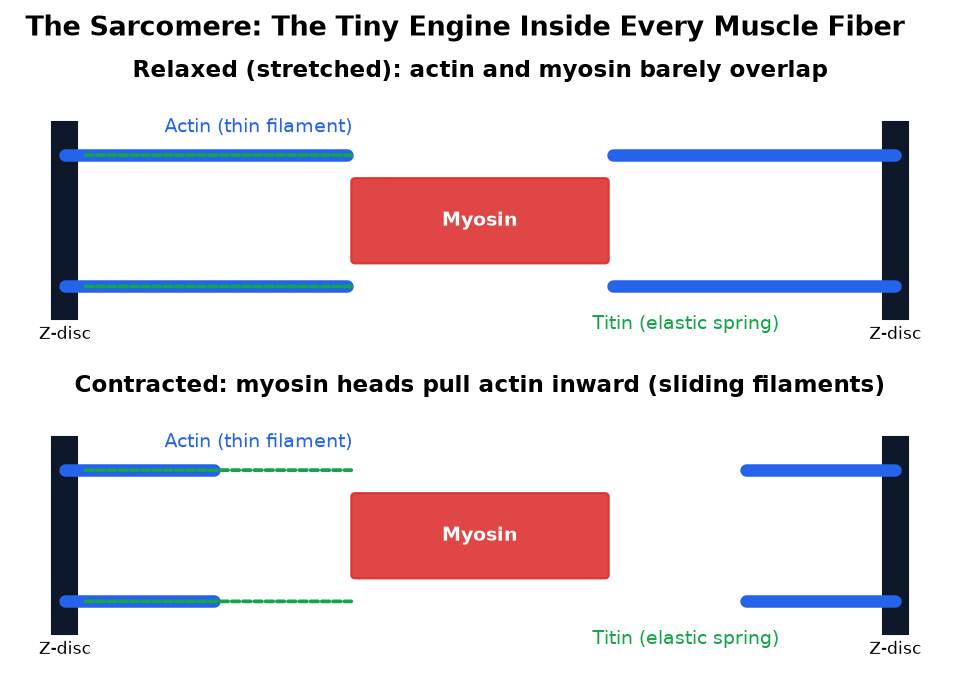
Figure 1.1 — The sarcomere, the smallest contractile unit. Myosin heads grab actin filaments and pull them inward; the whole unit shortens.
1.2 The microscopic tug-of-war (actin and myosin)
Inside each sarcomere are two teams of tiny rowers. Myosin heads reach out, grab the actin filaments, pull, let go, and grab again — thousands of pulls per second. Scientists call this the Sliding Filament Theory, but a 12-year-old can picture it: two tug-of-war teams dragging the rope shorter. This is the concentric (lifting) half of every rep in this book, and the reverse — controlling the rope as it slides back out — is the eccentric (lowering) half. The lowering half, done slowly, is where much of the growth signal lives, which is why nearly every masterclass in Chapters 3–6 nags you about slow negatives.
1.3 The bungee cord that senses stretch (titin and the force-length relationship)
Laced through every sarcomere is titin, the largest protein in your body — picture a giant molecular bungee cord anchoring the rowers to the ends of the unit. When a muscle is stretched under load (the bottom of an incline curl, the deep bottom of a fly), titin pulls taut and the stretched position becomes a powerful growth trigger. This is the mechanism behind stretch-mediated hypertrophy, the single biggest theme of the 26 videos: load the muscle while it is long.
Muscles also have a strength curve depending on their length — the force-length relationship. Most muscles pull hardest near the middle of their range and weakest when fully squeezed short or stretched to the extreme. That is why “resistance curves” (Chapter 2) matter: a great exercise challenges the muscle where the muscle is weakest and most responsive, usually the stretched position.
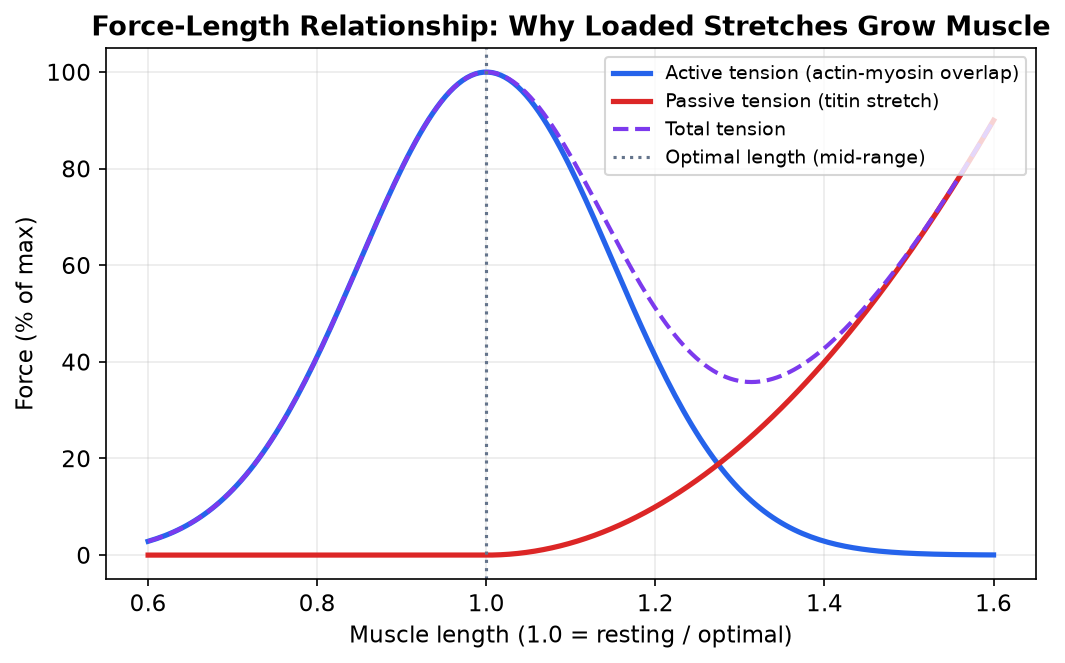
Figure 1.2 — Muscles produce the most force near mid-length and less when fully shortened or fully stretched. Great exercises load the long (stretched) side of this curve.
1.4 The light-switch system (motor units and why the last reps matter)
Your brain turns on muscle fibers the way you light up a house: small switches first, big switches only when needed. A motor unit is one nerve plus all the fibers it controls. Small units (slow-twitch, Type I endurance fibers — the marathon runners) switch on for easy work. Only when the weight is heavy or you are close to failure do the big units (fast-twitch, Type II fibers — the sprinters that actually grow large) flip on. This principle, Henneman’s Size Principle, is the entire logic behind training close to failure and tracking proximity to failure with RIR (Chapter 2): the last few hard reps of a set are the reps that recruit the growth fibers.
1.5 Marathon fibers vs sprinter fibers
Type I (slow-twitch) fibers resist fatigue and barely grow — they carry you through the day. Type II (fast-twitch) fibers are powerful, tire fast, and grow large — they are the target of everything in this book. Heavy-ish loads, sets taken near failure, and stretched-position loading all exist to make Type II fibers do the work.
1.6 Bricklayers vs demolition crew (MPS vs MPB)
Training does not build muscle in the gym; it sends the order. Muscle Protein Synthesis (MPS) is the bricklaying crew assembling new muscle protein afterward. Muscle Protein Breakdown (MPB) is the demolition crew clearing damaged protein. You grow only on days and weeks where the bricklayers outwork demolition — MPS greater than MPB. Two things tip the balance: a hard training stimulus (mechanical tension, especially in the stretch) and protein feedings that flip the build switch.
1.7 The construction foreman (mTORC1 and leucine)
Inside each fiber sits a foreman protein, mTORC1, that shouts “start building.” It listens for two signals: mechanical tension from lifting and the amino acid leucine from food. Each protein meal needs roughly 2.7–3.5 g of leucine to fully wake the foreman — whey, eggs, dairy and chicken clear that bar easily, which is why Chapter 8 spreads protein across four feedings instead of one giant dinner.
1.8 The battery and the fast charger (ATP and creatine)
Every myosin pull burns one molecule of ATP, the battery of the cell. The cell keeps a fast charger on hand, creatine phosphate, which instantly recycles dead batteries during hard sets. That is the entire logic of creatine supplementation (Chapter 8): a fuller fast charger means one or two extra reps before the lights dim.
1.9 Your full-body map
Before the atlas chapters, meet the territory. The front view carries the chest, front and side delts, biceps, abs, quads; the back view carries the lats, rear delts, triceps, glutes, hamstrings and calves. Every muscle below gets its own row in Chapters 3–6.
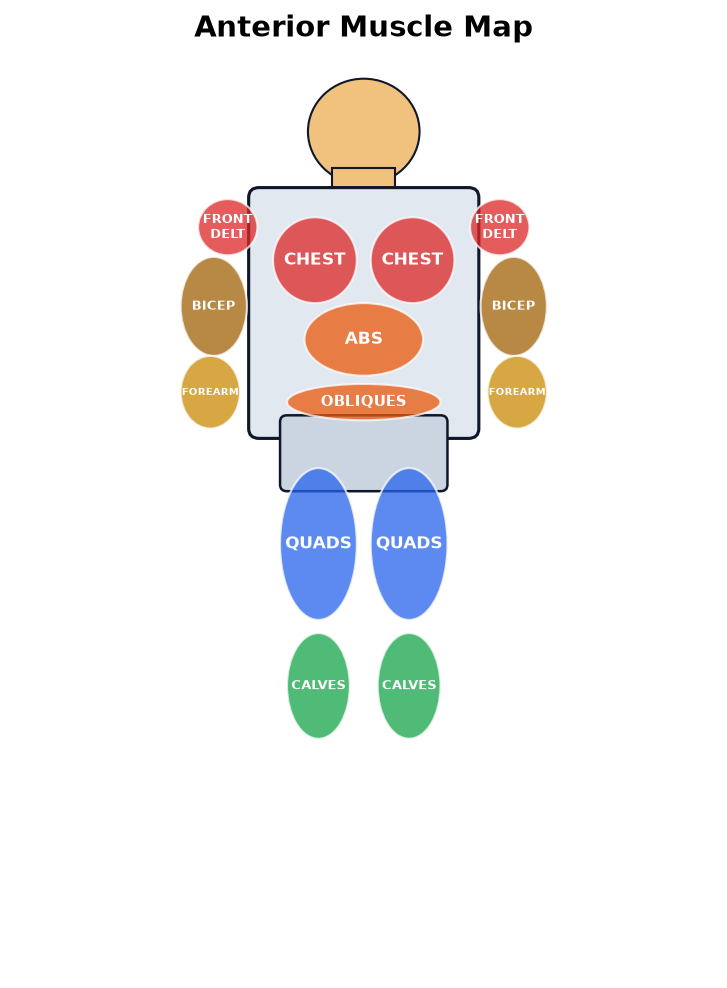
Figure 1.3 — Anterior (front) view: the pushing muscles and quads you will meet in Chapters 3, 5 and 6.
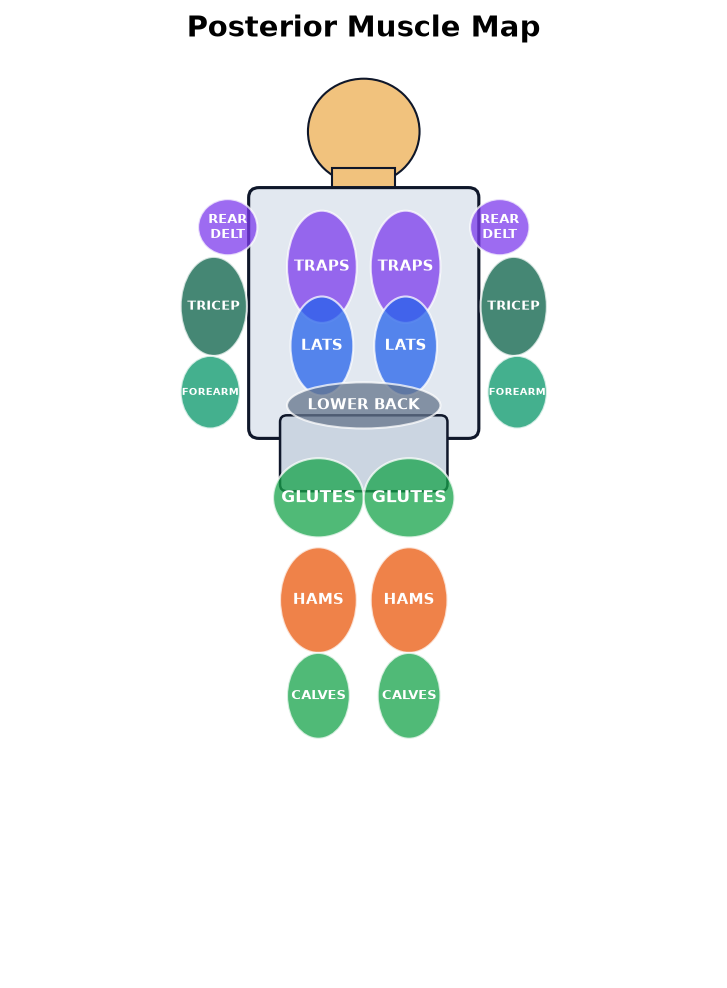
Figure 1.4 — Posterior (back) view: the pulling muscles, triceps, glutes, hamstrings and calves from Chapters 4 and 5.
Chapter 1 in one sentence: millions of tiny tug-of-war units, switched on small-to-large, grow when they are loaded while stretched and then fed protein — everything after this is details.
Chapter 2 — The Secret Gym Decoder Ring: Every Acronym Explained
Gym experts speak in code. This chapter decodes all 45 terms from the video transcripts into plain language, then adds the six coach-framing tools (SFR, RIR, DDP, volume landmarks, resistance curves, axial budget) you need for Chapter 8. Each term keeps its transcript example so you can hear how coaches actually use it.
2.1 The six tools you will use every week (coach framing)
SFR — Stimulus-to-Fatigue Ratio. The return on investment of an exercise: how much growth stimulus it gives the target muscle per unit of joint wear, spinal load and whole-body tiredness. High-SFR moves (seated cable curl with the torso braced, chest-supported rows, machine presses) isolate the target while the rest of the body rests. Low-SFR moves (spider curls that unload the stretch, waiter curls that cap loading at the wrists, heavy free compounds done sloppily) cost more than they pay. Every masterclass in this book carries an SFR rating so you can spend your recovery budget wisely.
RIR and RPE — the fuel gauge. Reps in Reserve (how many clean reps you had left) and Rating of Perceived Exertion (a 1–10 difficulty scale) measure the same thing from opposite ends: RPE 8 is roughly 2 RIR. Because big motor units only join near failure (Chapter 1), most growth sets in this book live at 0–2 RIR, with lighter ramp-up weeks at 3–4 RIR.
DDP — Dynamic Double Progression. A leveling-up system: pick a rep bracket (say 8–12), climb reps with the same weight until you hit the top at your RIR target, then add a little weight and drop back to the bottom of the bracket. Like finishing every side quest on a game level before entering the next dungeon. Chapter 8 shows a worked example.
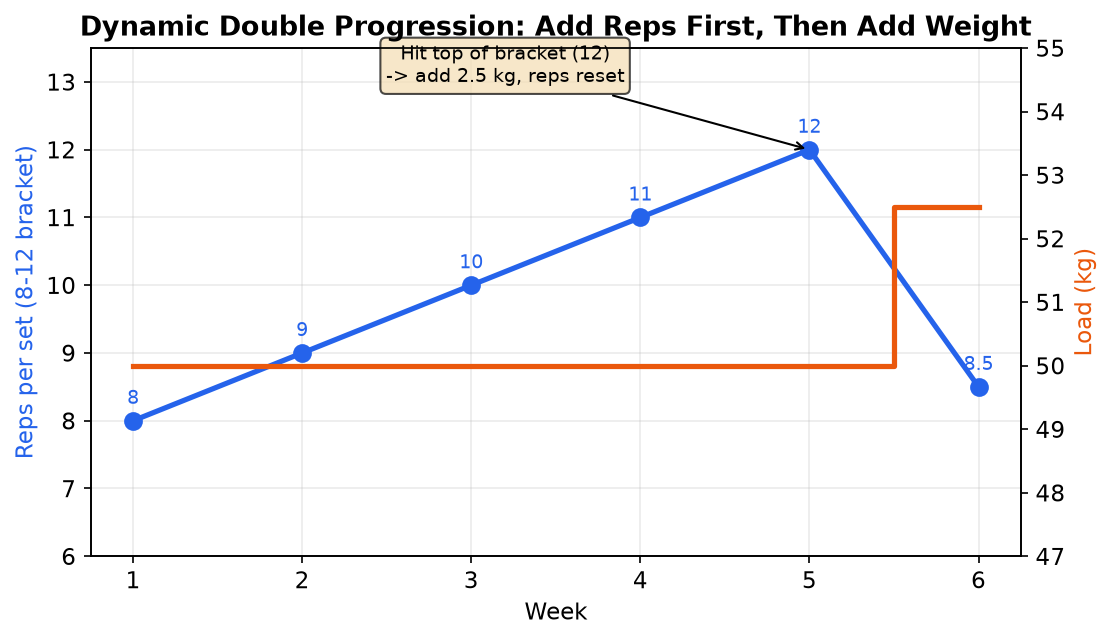
Figure 2.1 — Dynamic Double Progression: add reps until you conquer the bracket, then add load and climb again.
Volume landmarks — MEV, MAV, MRV. Minimum Effective Volume (the fewest weekly sets that trigger any growth, roughly 6–8 per muscle), Maximum Adaptive Volume (the sweet spot where you grow fastest, roughly 12–18), Maximum Recoverable Volume (the ceiling near 20–25, past which you overtrain). The glossary’s own metaphor: a sponge must dry out (deload) before it soaks up water again.
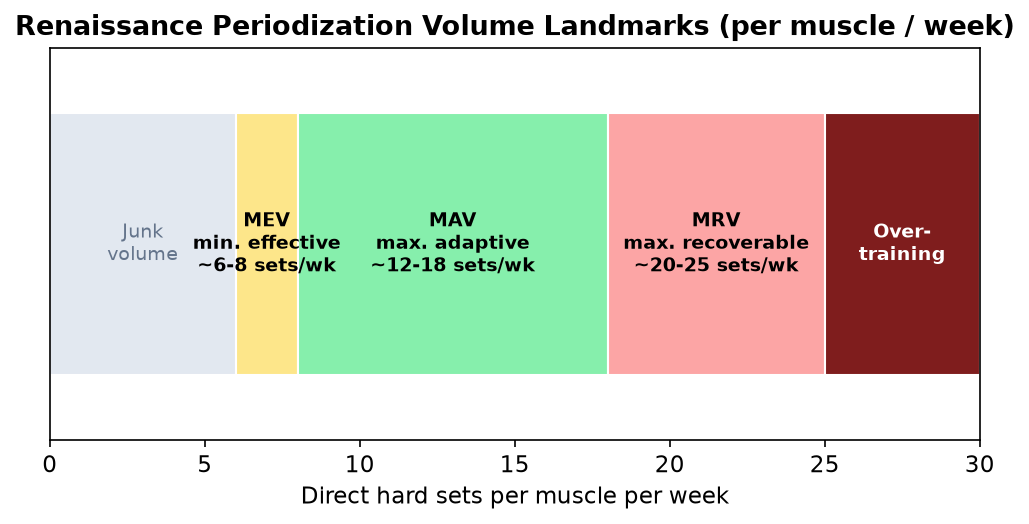
Figure 2.2 — Volume landmarks: below MEV you maintain, at MAV you grow fastest, past MRV you cannot recover.
Resistance curves — where a move feels hardest. Dumbbell moves are usually hardest in the middle and weightless at the top and bottom; cables pull evenly through the whole rep; machines depend on their cams. Matching the curve to the muscle’s weak point (the stretch) is half of smart exercise selection.
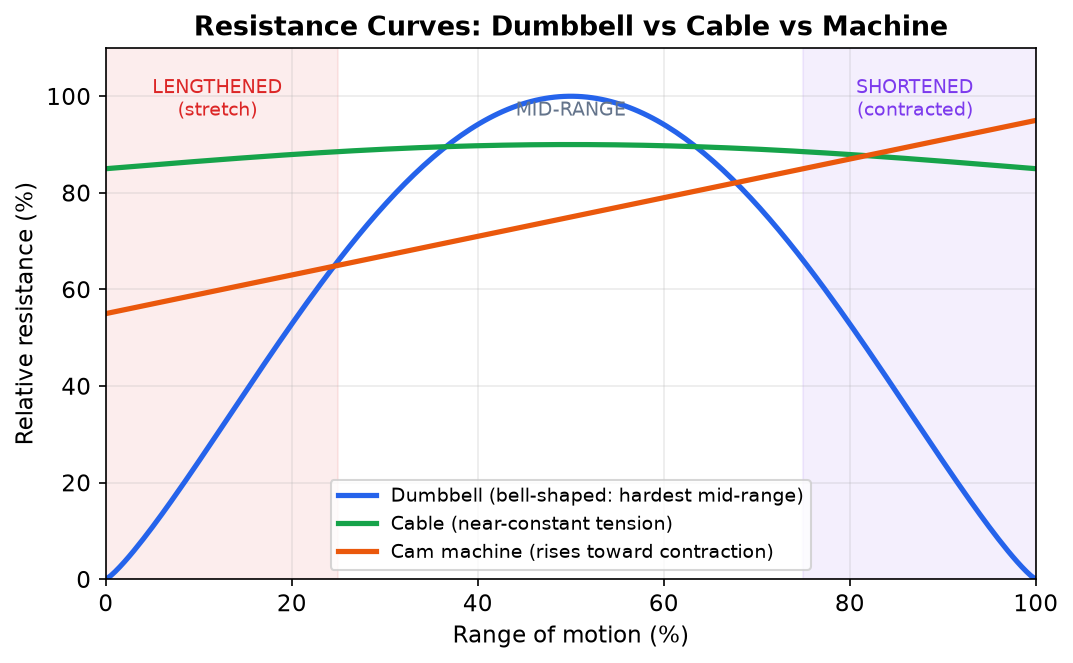
Figure 2.3 — Resistance curves: free weights peak mid-rep and die at the ends, cables pull evenly, which is why cables often win for constant tension.
Axial budget — your spine’s weekly allowance. Heavy compressive spinal loading (back squats, deadlifts, bent rows) may sit on the spine only 1–2 times per week; everything else should be seated, braced or machine-supported. Spend the budget once, then bank the savings. (Full diagram in Chapter 8.)
2.2 All 45 transcript terms, decoded
| Term | Plain-English meaning (ELI12) | How coaches use it — transcript example |
|---|---|---|
| 1RM (One-Rep Max) | Your max lift for one clean rep, like the heaviest box you can lift exactly once. | Worked back from light triples toward previous 1RM / 3RM hip-thrust weights with better form. |
| Active range | Only the depth you control with the target muscle, like bending only as far as you stay balanced. | End the leg press where glutes stay on the seat; do not chase social-media depth past active range. |
| Active insufficiency | A two-joint muscle goes slack at one end so it pulls weakly, like a rope with slack at one corner. | Bent knee shortens the gastroc at the knee so it contracts weakly at the ankle and the soleus takes over. |
| Cheat reps / negative | A little body swing lifts the weight up, then you fight it slowly down, like pushing a swing then catching it. | Cheat curls use momentum on the way up then a controlled lowering (negative) phase. |
| Constant tension | Never resting the weight at the top or bottom, like keeping a stretched rubber band tight the whole set. | Stop the dumbbell press at shoulders-over-shoulders to keep constant tension for the next rep. |
| Deload | A planned easy week so muscles resensitize, like letting a sponge dry out so it soaks up water again. | Take 1–2 weeks off calves or cut volume about 50 percent to resensitize before pushing volume again. |
| Eccentric | The lowering half of a rep where the muscle lengthens under load, like slowly lowering a heavy bucket into a well. | Slow eccentric on every incline curl rep; lower the hip-thrust bar under control with the glutes. |
| Eccentric and concentric control | Commanding both the lowering and lifting halves of each rep, like driving carefully downhill and uphill. | Every seated leg-curl rep touches end range and returns to full stretch under both-phase control. |
| EMG activation (Electromyography) | Sensors on the skin hear how loudly a muscle fires, like a microphone held over a crowd. | 2020 EMG study across 0–60 deg showed peak upper-pec activity at 30 deg; higher EMG needs cautious reading for growth. |
| Exercise order / programming | Which move goes first and last in a workout, like eating the main dish before dessert. | Start with the steepest upper-pec press angle, finish with a 0–15 deg press plus one fly. |
| Failure | The point where you cannot do one more clean rep, like running until your legs simply stop. | Versa grips take grip out so sets reach true back failure for better lat stimulus. |
| Full range of motion (Range of Motion) | Moving a joint through its whole safe path, like opening a door all the way instead of halfway. | Study compared full range of motion vs lengthened partials in trainees (biceps video). |
| Full ROM / partial ROM | Full reps travel the whole path; partials work a slice of it, like full door swings vs small pushes. | Pull to the chin only instead of full ROM to the chest for an efficient lat growth range. |
| Hypertrophy | Muscles growing bigger from training, like a road widening after years of heavy traffic. | Elongation and stretch described as a driver of biceps hypertrophy on incline curls. |
| Intensity technique / metabolic stress | End-of-workout tricks like 21s that flood the muscle with burn, like a final sprint that leaves legs tingling. | Reserve cable-fly 21s for the end of the chest workout for extra metabolic stress. |
| Isolation | One muscle does almost all the work, like a solo singer instead of a choir. | Lead through the elbow to isolate and work the shoulders (cable lateral). |
| Isometric hold | Freezing a weight still without moving, like holding a heavy grocery bag halfway up the stairs. | One arm curls while the other holds mid-rep isometrically (drop-curl setup). |
| Lengthened partials | Short reps done only in the stretched bottom half, like bouncing a ball only near the floor. | Modified 21s end with bottom-half lengthened partials past rep 7 for biceps. |
| Lengthened position | The bottom stretch where the muscle is longest, like a slingshot pulled all the way back. | Bottom of the leg-press rep is the lengthened position where glutes are most challenged. |
| Loadability | How easily you can add weight to a move, like stairs with clearly marked heavier steps. | Whether an ab exercise can be progressively loaded with stack, plates, or dumbbells. |
| Mind-muscle connection | Deliberately feeling the target muscle squeeze each rep, like listening closely to one instrument in a band. | Feel the calves working each rep instead of bouncing; feel delts engaging with a burn at higher reps. |
| Modification and regression | An easier version of a hard move, like training wheels before a two-wheel bike. | Chair-supported and bent-knee options scale the hanging leg raise for any level. |
| Negative (Eccentric lowering phase) | The slow lowering part of a rep, like gently setting down a fragile box. | Controlled eccentric / negative phase on seated calf raises emphasized over bouncing reps. |
| Peak contraction | The top squeeze where the muscle is shortest, like wringing the last water from a towel. | Kong curl praised for good tension at peak contraction of the biceps. |
| Peak contraction hold | Pausing and squeezing at the very top, like freezing at the top of a flex for a photo. | Flex and hold at the top of each cross-body hammer cable curl. |
| Progression | A lift that lets you add weight or reps over weeks, like climbing a ladder one rung at a time. | Lifts ranked on stretched tension, feel, and simple progression (triceps ranking video). |
| Progressive overload | Slowly asking muscles for a little more over time, like adding one page to your reading each night. | Add weight or reps over time; standing calf raises 6–8 reps to failure progressed over 24 years. |
| Proximity to failure | How close a set stops to the point you could not continue, like parking near but not on the wall. | Bodyweight ab moves fail lifters when they cannot reach failure in reasonable reps. |
| Range of motion | How far a joint travels during a rep, like how wide a door swings open. | Full heel-below-toe calf range; incline press to at least 90-deg elbow bend; glute bridge uses smaller range than hip thrust. |
| Regression | The easier cousin of a tough exercise, like knee push-ups before full push-ups. | Back pad limits swinging, making the captain’s-chair knee raise easier than a free hanging raise. |
| Rep range | The target number of reps per set, like a recipe saying 8–12 cookies per batch. | Pulldowns 15–25 vs pull-ups 5–10; heavy curls 6–8; cable flyes 15–20 as pump work. |
| Resistance leverage | Where gravity pulls hardest in a move, like a seesaw feeling heavier at one end. | Legs are the load in raises; past vertical, gravity acts through the leg and tension drops. |
| Sets x reps (Sets by Reps) | The workout recipe: how many rounds times how many lifts, like 3 verses of 8 lines each. | 3–4 sets of 8–12 reps per arm on the half-kneeling single-arm cable pulldown. |
| Stabilization requirement | Extra balance work a move demands, like carrying soup on a wobbly tray. | Unwanted fatigue in lats, arms, or hips that steals stimulus from the abs. |
| Stretch emphasis | How much a move loads the muscle while stretched long, like feeling the pull in a stretched rubber band. | How much tension and length the abs get in the stretched position (ab ranking criterion). |
| Stretch reflex | The bounce-back energy at the bottom of a rep, like a ball springing off the floor. | Dip into the incline-curl bottom then explode up using the stretch reflex. |
| Tempo (Repetition tempo) | The speed recipe for each rep, like counting dance steps: down slow, pause, up quick. | About 4-sec lowering, slight pause, 1-sec press on incline DB press; very slow first half of drop curls. |
| Tempo / slow negative | Stretching the lowering phase long on purpose, like slow-motion replay of setting down weight. | Slow release on every cross-body hammer cable curl rep with no momentum. |
| Tier list | Grading exercises S to F like school report cards for muscle growth. | Every biceps exercise ranked S / A / B / C / F on stretch tension, feel, and progression criteria. |
| Tier ranking | Same report-card grading applied to a whole exercise menu, like ranking ice-cream flavors best to worst. | S / A / B / C / D tiers used to rank every ab and oblique exercise. |
| Time efficiency | How much muscle work you get per minute, like choosing the shorter checkout line. | Stack weight selection with no setup versus time-costly bodyweight ab holds. |
| Time under tension | Total seconds a muscle strains during a set, like how long you hold a heavy door shut. | Pulldown sets feel less taxing over similar time under tension; slow 3-2-1 calf lowering maximizes it. |
| Training frequency / split | How often each muscle gets trained weekly, like watering plants on a fixed schedule. | Add incline DB press once weekly plus flat and slight-decline biases. |
| Training volume | Total work done, usually sets times reps, like total pages read in a week. | Use the cable fly to add extra chest volume without creating too much overall fatigue. |
| Training volume and frequency | How much work plus how often, like homework amount times school days per week. | Fix calf technique first; upper range about 70 reps per session 3x weekly cited before adding volume. |
How the pieces fit. Pick high-SFR moves whose resistance curve loads the lengthened position, progress them with DDP inside the right rep range at 0–2 RIR, keep weekly volume between MEV and MRV, and spend your axial budget once a week. That single paragraph is the whole training philosophy of this book.
Chapter 3 — The Upper Body Pushing Atlas: Chest, Front and Side Delts, Triceps
Push-day muscles shove weight away from the torso. This chapter covers the chest, the front and side delts (rear delts pull, so they live in Chapter 4), and the triceps. Overhead pressing belongs to the full edition (its videos are among the 28 missing), so shoulders here mean incline pressing plus lateral raises.
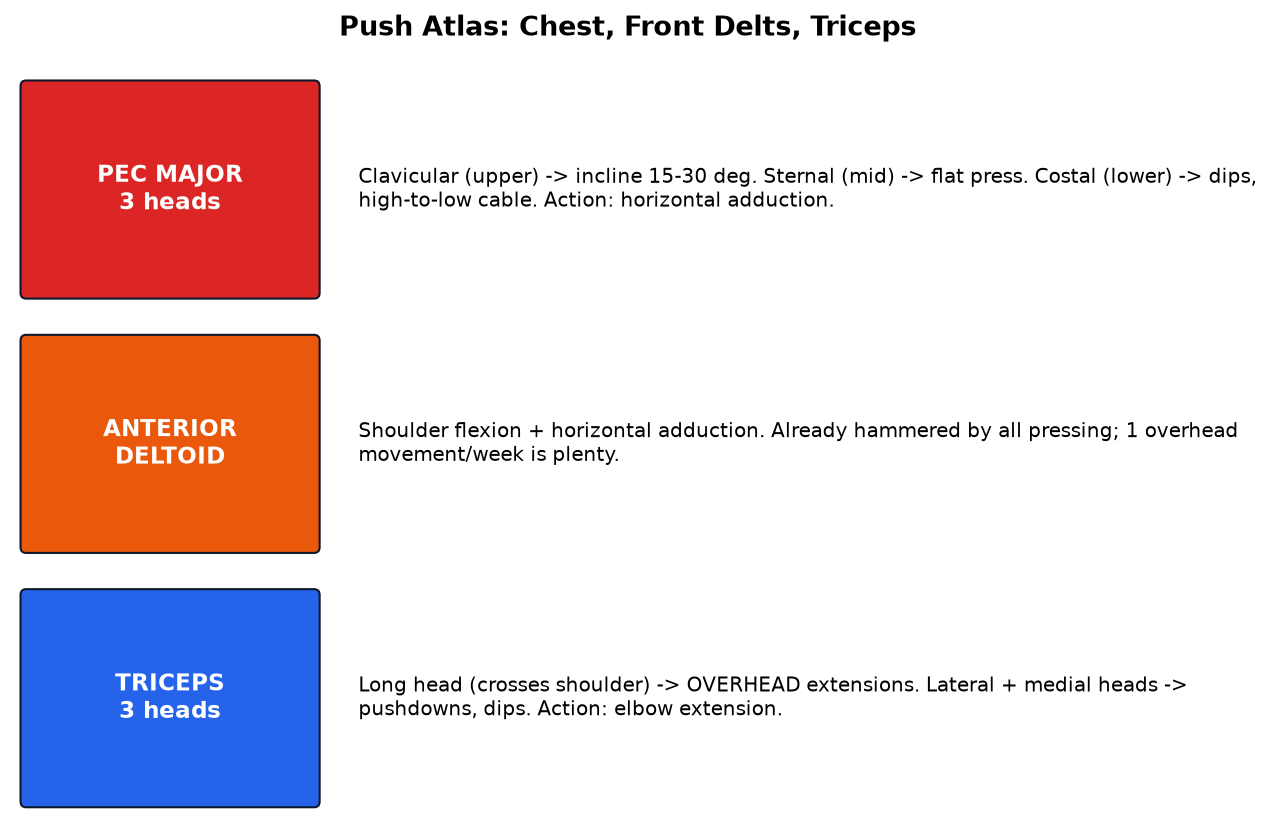
Figure 3.1 — The pushing atlas: upper, middle and lower pec fibers, front and side delts, and the three triceps heads.
3.1 Anatomy table
| Muscle | Heads | What it does (actions) | Picture it (ELI12) |
|---|---|---|---|
| Pectoralis Major | Clavicular (upper), sternal (middle), costal (lower) — one shared humeral insertion | Horizontal shoulder adduction (hugging the arm inward); shoulder flexion via clavicular fibers | Like three fan blades on your chest — upper, middle, lower — that hug your arm inward the way you would slam a door with your forearm. |
| Anterior Deltoid | Single head (front cap) | Shoulder flexion; horizontal shoulder adduction (assists presses and flyes) | Like the front cap of a shoulder pad that lifts your arm forward, the way you would raise your hand to answer a question. |
| Lateral Deltoid | Single head (side cap) | Shoulder abduction (lifting the arm out to the side to parallel) | Like a side handle on a bucket that lifts your arm sideways, the way a bird raises its wing away from its body. |
| Triceps Brachii | Long head, lateral head, medial head | Elbow extension; shoulder extension via the long head (moving the arm down) | Like a three-rope horseshoe on the back of your arm that straightens the elbow, the way you would push a door shut. |
Stretch tips from the transcripts. Chest: set up with a slight pec stretch, externally rotate at the bottom, control the negative; a 15–30 deg incline biases upper fibers while pinched blades lengthen the pec around the ribcage. Front delts: keep incline at 15–30 deg so the pec leads before the front delt takes over. Side delts: lean the torso in holding a support so the dumbbell loads the stretched bottom, lower over 3–4 seconds, stop at parallel. Triceps: overhead positions load the long head in the deep stretch (extend fully, keep it smooth); for the lateral and medial heads, pin elbows in front of hips on pressdowns and drive apart at the bottom.
3.2 Chest masterclasses
Incline dumbbell press (Mind Pump TV, Jeremy Ethier) — SFR moderate, descending curve, stretch-biased. Setup: bench at 15–30 deg (1–2 notches), feet planted, back, head and butt on the bench, ~45-deg tuck, weights to mid-chest. Cues: (1) Pinch the shoulder blades together and keep the chest up, like squeezing a pencil between them. (2) Tuck elbows halfway between flared and glued, forearms straight up and down. (3) Lower for about 4 seconds, pause, press in 1 second. (4) Stop with arms straight over shoulders; never clink the dumbbells. (5) Breathe in going down, brace, breathe out pressing. Mistakes: bench too steep so shoulders do the work; flared elbows or caved forearms; rolling shoulders forward at lockout or diving past chest-tension depth; touching dumbbells together past the shoulders. Why moderate SFR: free dumbbells demand heavy balancing and shoulder control, so fatigue runs higher than a guided press for similar chest work.
Incline bench press, 15–30 deg (John Jewett) — SFR moderate, descending curve, stretch-biased. Setup: bench 15–30 deg, grip stacks wrist over elbow at the bottom, elbows ~45 deg, thumbs wrapped, head down. Cues: (1) Set the angle where you feel the chest squeeze before the shoulders jump in. (2) Pull the blades back to stretch the chest around the ribs. (3) Wrist over elbow, elbows ~45 deg. (4) Wrap thumbs fully and squeeze the bar like wringing a towel. (5) Keep the head glued down so the angle never shifts. Mistakes: 45 deg or steeper turns it into a front-shoulder lift; too-wide grip cuts range, too-narrow becomes triceps work, 90-deg flare stresses shoulders; thumbless grip or lifted head shifts the angle. Coach note: a 2020 EMG study across 0–60 deg found peak upper-pec activity at 30 deg — read EMG cautiously, but the 15–30 deg window is the consensus.
Flat dumbbell press (Jeremy Ethier) — SFR moderate, descending curve. Setup: flat bench, elbows tucked 45–60 deg with a slightly inward grip, dumbbells travel to mid-chest and back over shoulders. Cues: (1) Tuck 45–60 deg, grip angled slightly inward in line with the fibers. (2) Lower forward to mid-chest, press back toward the shoulders, not straight up. (3) Keep forearms vertical; go lighter if they cave. (4) Pinch the blades, tall chest, never round. (5) Stop over the shoulders, no clinking. Mistakes: straight up-and-down pressing with wide flare (front delts take over); forearms bending inward (triceps take over); rounded shoulders; clinking past the shoulders.
Flat bench press, 0–15 deg (John Jewett) — SFR moderate, descending curve, stretch-biased. Setup: bench flat to 15 deg, wrist over elbow, ~45-deg tuck, blades back, thumbs wrapped. Cues: (1) Favor 0–15 deg since it trains upper, middle and lower fibers together. (2) Wrist stacked over elbow, ~45-deg tuck for the biggest safe range. (3) Blades back first so the chest stretches and shoulders stay out. Mistakes: chasing only steep incline and leaving mid and lower chest behind; 90-deg flare or poor stacking that shrinks range and stresses shoulders. Programming from the transcripts: start with the steepest upper-pec angle, finish with a 0–15 deg press plus one fly.
Slight-decline dumbbell press (Jeremy Ethier) — SFR moderate, descending curve. Setup: bench foot raised slightly, same tuck and mid-chest path as flat. Cues: (1) Raise the bench foot slightly, keep the 45–60 deg tuck. (2) Lower to mid-chest, press back toward the shoulders, vertical forearms. (3) Pinched blades, chest up, stop over the shoulders. Mistakes: wide flare pressing straight up; forearms caving to triceps; rounded shoulders.
Low-to-high cable fly (Jeff Nippard) — SFR high, constant curve, stretch-biased. Setup: pulleys low, arms ~15–30 deg out, staggered stance stepping forward to a light chest stretch. Cues: (1) Blades back and down first, as for a bench press. (2) Pinkies out at the bottom to lengthen fully, rotating inward as you lift. (3) Pull the insides of the elbows toward each other, finishing thumbs-to-thumbs. (4) Elbow bend frozen like a hinge; move only at the shoulder. (5) Light weights, 15–20 reps, stretched slow negative every rep. Mistakes: bending and straightening the elbows (becomes a triceps press); losing the pinched blades and rounding forward; going too heavy with sloppy short reps. Why high SFR: cables pull evenly with the torso braced and no spinal loading, so the chest works hard while the rest of the body rests.
Pec fly, lengthened-position finisher (John Jewett) — SFR high, descending curve, stretch-biased. Setup: one isolation fly at the end of chest day, loaded so the stretched bottom feels hardest. Cues: (1) Save it for last when the chest is warm and tired. (2) Pick a load that still challenges the deep stretched bottom. (3) Control the negative; let the stretch do the growing work. Mistakes: placing the fly first and gassing out before heavy presses; bouncing out of the bottom. Use the cable fly to add extra chest volume without much overall fatigue.
3.3 Side-delt masterclasses
Dumbbell lateral raise, all variants (Renaissance Periodization, Jeff Nippard) — SFR moderate, bell-shaped curve, stretch-biased. Setup: standing or seated, dumbbells at sides, raise to parallel. Variants: lean-in holding a support for stretch; lean forward 15–30 deg for rear bias; super-ROM only with light weights. Cues: (1) Raise to shoulder height and stop; higher adds ache, not muscle. (2) Pick a slight elbow bend and keep it. (3) Lower over 3–4 seconds; never let gravity drop the weight. (4) Pause a full second at the top on strict reps, and drop the weight when you add the pause. (5) Lean-in variant: lean the torso in holding a rack so the side delt pulls hardest while stretched. Mistakes: pinkies-up thumbs-down reps forced overhead until the shoulder pinches; combining forward lean with thumbs-down super-high reps (worst mix for shoulders); keeping the same heavy weight when switching to paused or slow reps; only ever doing upright reps, which give the stretched delt almost zero tension. Why moderate SFR: standing free weights need balance and invite cheating and pinching, so each hard set costs more than it looks.
Behind-the-back cable lateral raise (ResilientPT) — SFR high, constant curve. Setup: single low pulley, handle gripped behind the back at butt height, arm sweeping out to shoulder level. Cues: (1) Stand close, pulley at the very bottom, handle starting behind the butt. (2) Lead with the elbow, like opening a wing, not the hand. (3) Tiny soft elbow bend, stop right at shoulder height. (4) Return slowly all the way to the butt before the next rep. Mistakes: standing too far so the cable drags the arm across the body; raising past shoulder height, dumping tension into traps and neck. Why high SFR: the fixed cable path and still torso give the side delt steady tension with no balancing or spinal cost.
3.4 Triceps masterclasses
Pressdown, V-bar / straight-bar / rope / reverse-grip (ScottHermanFitness, Jeff Nippard) — SFR high, constant curve. Setup: high cable, elbows pinned in front of hips, press to full lockout, rise to just past 90 deg. Cues: (1) Pin elbows in front of the hips and glue them there. (2) Stand tall, neutral spine, step slightly back, press straight down. (3) Breathe out on every press, lock out fully. (4) Rise only to just past 90 deg, then press back down; rope lets you spread apart at the bottom, bar moves the most weight. (5) Add a rep or a little weight week to week; reverse grip only if it clearly feels better. Mistakes: elbows drifting behind the hips, bleeding tension off; expecting pressdowns to stretch the long head (the top never lengthens it); underhand grips that fail in the hands before the triceps finish. Targets the lateral and medial heads; pair every pressdown with one overhead move for the long head.
Overhead cable extension, bar / rope / katana (Jeff Nippard) — SFR high, constant curve, stretch-biased. Setup: cables at height, arms overhead facing away, full elbow extension; katana variant crosses dual cables at waist height in the scapular plane. Cues: (1) Face away with arms overhead, straighten the elbows fully every rep. (2) Keep it smooth so the deep stretch never goes slack. (3) Bar moves the most weight; rope runs close behind; katana uses two crossed cables, arms ~30–40 deg forward in the shoulder-blade plane. (4) Never rely on pressdowns alone. Mistakes: skipping overhead work and leaving the long head half-trained; learning the crossed-cable katana with heavy weight before owning the arm path; treating the rope’s wobble as a dealbreaker instead of steadily adding reps. Top-rated stretch plus cable steadiness: maximum long-head tension with the body parked and spine unloaded.
Dumbbell overhead extension, seated French press / one-arm (Jeff Nippard) — SFR moderate, descending curve, stretch-biased. Setup: seated, dumbbell(s) overhead, lower deep behind the head and extend; one arm if two-arm feels bulky. Cues: (1) Sit so the body cannot rock and steal tension. (2) Lower to a deep stretch behind the head, then extend fully. (3) Go one arm at a time when two-arm reps feel bulky or bang the wrists. (4) Angle the working elbow wherever the shoulder feels happiest. Mistakes: wrestling oversized dumbbells that strain the wrists; sticking with clumsy two-arm reps when single-arm reps stretch deeper.
EZ-bar skull crusher (Jeff Nippard) — SFR moderate, descending curve, stretch-biased. Setup: lying with an EZ-bar, elbows slightly back, arc behind the head to a deep stretch, then extend. Cues: (1) Arc the bar down behind the head, not straight onto the skull. (2) Start each rep with elbows tipped slightly back so tension grabs instantly. (3) Lower slowly into the stretch; never bounce. Mistakes: chopping straight up and down with zero backward arc; flaring elbows or cutting range so the stretch never loads. Lying support is stable, but heavy elbow loading in the stretch can irritate elbows — cap the load and keep reps clean.
Triceps kickback, cable preferred / dumbbell option (Jeff Nippard) — SFR moderate, flat-shortened curve. Setup: torso hinged or upright, low cable (or dumbbell), kick the arm back behind the torso and squeeze. Cues: (1) Kick the arm back behind the torso and keep it there — that back position is the whole exercise. (2) Higher reps, squeeze each lockout hard. (3) Prefer cables; the pull stays even everywhere. Mistakes: picking dumbbell kickbacks as the main long-head grower when they load only the squeeze; swinging instead of squeezing under control.
Close-grip bench press (Jeff Nippard) — SFR moderate, constant curve. Setup: barbell bench, close grip, lower to the chest, press through the triceps. Cues: (1) Grip close, lower to the chest, press mostly with the triceps. (2) Add a little weight each week — this press overloads smoothly for years. (3) Always pair with one overhead extension for the long head. Mistakes: running presses alone and wondering why the back of the arm stays flat (the long head shortens at the shoulder here); gripping so narrow the wrists ache. Heavy pressing splits fatigue across chest, shoulders and elbows, diluting the triceps payoff — a compound seasoning, not the main course.
Chapter 3 in one sentence: press on a slight incline for the upper chest, finish with a stretch-loaded fly, raise laterally to parallel with slow negatives, and always pair a pressdown with one overhead extension.
Chapter 4 — The Upper Body Pulling Atlas: Back, Rear Delts, Biceps
Pull-day muscles drag weight toward the torso and bend the elbow. Honest scope note: the covered videos teach vertical pulling (pulldowns, pull-ups) and elbow flexion in depth, but barbell and chest-supported rows, face pulls and rear-delt flyes belong to the 28 missing videos — so upper-back thickness work and rear-delt isolation arrive with the full edition. What follows is complete for lats and arms.
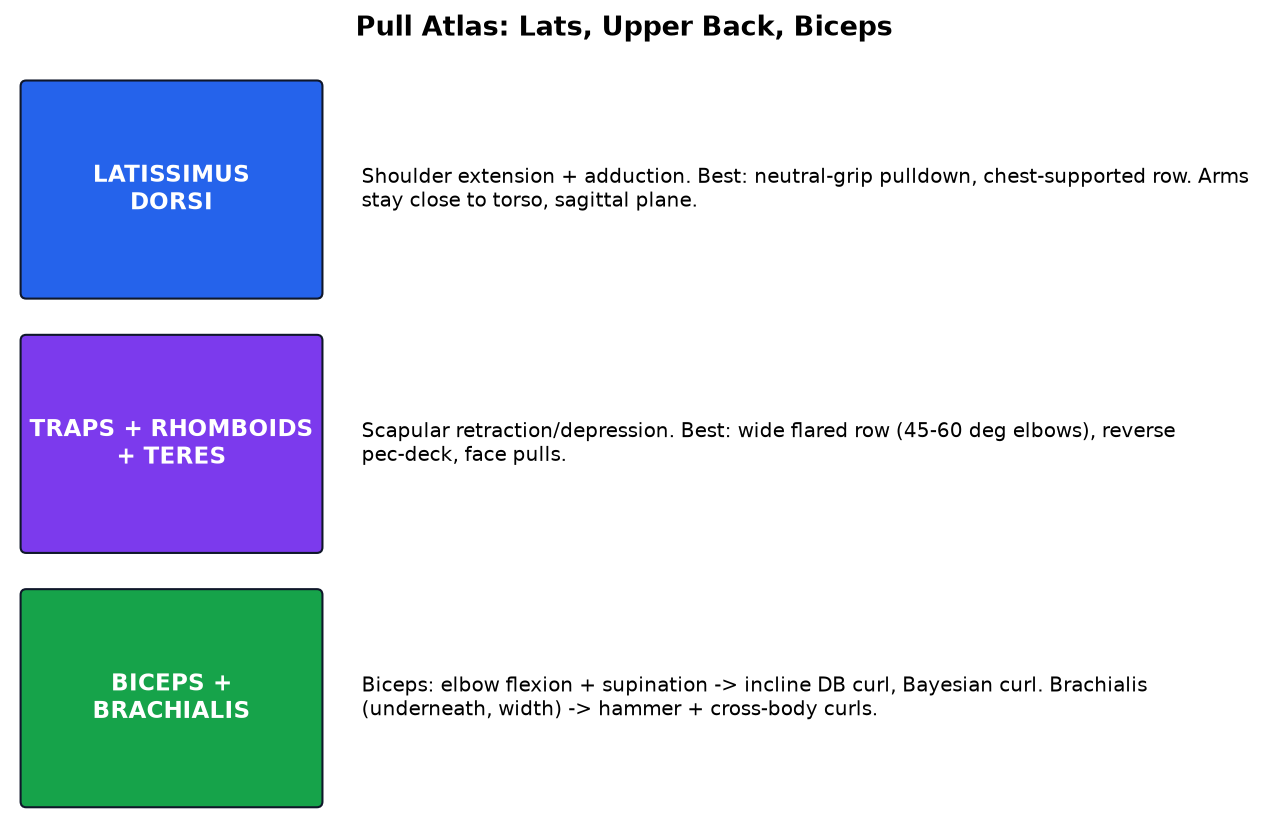
Figure 4.1 — The pulling atlas: lat wings, rear-delt bumper, and the biceps / brachialis / brachioradialis stack on the front of the arm.
4.1 Anatomy table
| Muscle | Heads | What it does (actions) | Picture it (ELI12) |
|---|---|---|---|
| Latissimus Dorsi | Broad single sheet each side | Shoulder adduction (elbow pulled down to torso / chin); scapular retraction and depression at the finish | Like two wide wings on your back that pull your elbows down to your ribs, the way you would yank a heavy window shutter closed. |
| Posterior Deltoid | Single head (rear cap) | Horizontal shoulder abduction (arm lifted out while leaning forward) | Like a rear bumper muscle that pulls your arm back and out, the way you would open a heavy sliding door behind you. |
| Rotator Cuff | Four small stabilizers (SITS group) | Assists the first ~20 deg of a lateral raise; shoulder stabilization | Like a small team of ropes holding your shoulder ball in its socket, steering the first few inches of every lift. |
| Biceps Brachii | Long head (outer peak), short head (inner) | Elbow flexion; supination (turning the palm up) | Like two cords on the front of your arm, inner and outer, that bend the elbow and twist the palm up like turning a doorknob. |
| Brachialis | Single thick pad under the biceps | Elbow flexion, especially with pronated or neutral grip | Like a thick pad hidden under the biceps that pushes the peak taller, the way stuffing pushes up a pillow. |
| Brachioradialis | Single forearm strap | Elbow flexion with neutral or angled grip | Like a forearm strap from elbow to thumb-side wrist that takes over when you grip sideways, like carrying a hammer. |
Stretch tips from the transcripts. Lats: shoulder-width or just-inside grip, ~2-sec dead-hang stretch at the top, slow eccentric through the top two-thirds, start protracted leaning slightly forward. Rear delts: lean the torso forward 15–30 deg, start the cable at butt height, stop at shoulder height, lead through the elbow. Biceps long (peak) head: arms behind the torso — incline curls with hanging arms vertical, face-away Bayesian curls, or lying curls, all the way to full extension; standard supinated curls target the short (inner) head. Brachialis: neutral hammer grips curled across toward the opposite shoulder, braced on a preacher bench, or very slow through the first half stopping at mid-rep where the brachialis works most. Brachioradialis: angled (EZ-bar) or neutral grips shift tension here; drive through the pinkies on the outer angled grip to keep the biceps firing.
4.2 Lat masterclasses
Lat pulldown, narrow / parallel-grip / single-arm cable (Renaissance Periodization, Jordan Syatt) — SFR high, constant curve, stretch-biased. Setup: seated pulldown, shoulder-width or just-inside grip; single-arm variant half-kneels under a high cable, leaning forward stretched then pulling tall. Stop at chin or a light chest touch. Cues: (1) Shoulder-width or just-inside grip; narrower stretches the lats more at the top. (2) Hang into a full 2-sec stretch and slow the way down through the top two-thirds. (3) Elbows tight to the ribs on parallel-grip reps. (4) Touch the chest lightly with no pause, or stop at the chin. (5) Single-arm variant: start leaning forward stretched, pull tall with the shoulder down, elbow stopping at the ribs, 3–4 sets of 8–12 per arm. (6) Use straps or Versa grips so the hands never quit before the back. Mistakes: pausing at the chest, burning energy in the weakest position; extra-wide grips that steal the top stretch; flaring elbows or dragging them past the torso (turns the pull into a row); shrugging the shoulder to the ear instead of pulling it down and back. Why high SFR: seated and braced with thighs pinned, the lats stretch under load while grip aids erase hand fatigue. Rep homes from the transcripts: pulldowns 15–25 vs pull-ups 5–10 — each has its own best rep home.
Pull-up, weighted / bodyweight / assisted (Renaissance Periodization) — SFR moderate, constant curve, stretch-biased. Setup: hang with bodyweight, added weight, or band / machine help; full stretch at the top of each rep. Cues: (1) Keep pull-ups heavy: 5–10 weighted, or 10–15 bodyweight. (2) Same recipe as pulldowns: dead-hang stretch, slow top-two-thirds negative, chin-level finish. (3) Add band or machine help to stay in the rep window instead of grinding ugly singles. Mistakes: copying the high-rep pulldown plan onto pull-ups or vice versa; kipping or half-hanging to chase reps the lats never feel. Why moderate SFR: free-hanging pulls tax grip, arms and abs hard, so the lats rarely fail first the way they do on a braced pulldown.
Narrow-grip assisted pull-up, brachialis emphasis (ATHLEAN-X) — SFR moderate, constant curve. Setup: narrow overhand grip with band help; 10–12 slow reps driven by the upper-arm and back muscles. Cues: (1) Narrow overhand grip takes the biceps mostly out. (2) Band help earns 10–12 clean reps with the wider back muscles driving. (3) Full bottom stretch, chest toward the bar, no swing. Mistakes: going so heavy the biceps and forearms quit while the brachialis barely works; kipping reps that should be slow builders.
Chin-up (Jeff Nippard) — SFR moderate, bell-shaped curve. Setup: palms-facing bodyweight hang; chin over the bar, controlled lowering. Cues: (1) Palms facing, pull until the chin clears. (2) Handy bodyweight volume for arms and back, not the main biceps builder. (3) Control the lowering instead of dropping. Mistakes: programming chin-ups as the only biceps work — the back always quits first and caps arm tension.
4.3 Biceps and brachialis masterclasses
Standing curl, barbell / EZ-bar / dumbbell / cable (Jeff Nippard) — SFR moderate, bell-shaped curve. Setup: standing, arms at sides — straight bar, EZ-bar outer grip, both dumbbells together, wall-braced strict, or slight-swing cheat; cable-at-sides as even-tension backup. Cues: (1) Curl both arms together rather than alternating so each side rests less and works more. (2) On EZ-bars use the outer angled grip and drive through the pinkies. (3) Run heavy bar versions in the 6–8 range, adding a little weight weekly. (4) Strict variant: pin glutes, upper back and head to a wall; cheat variant: borrow a little leg swing, then own a slow negative (experienced lifters only). (5) Cable-at-sides gives even pull but no pre-stretch — backup volume. Mistakes: alternating arms with long dead rests; angled grips without the pinky cue (work drifts to forearms); beginners cheating wildly before earning strict reps. Standing free curls are spine-friendly but invite body English and carry zero bottom tension.
Incline dumbbell curl (Jeff Nippard, ATHLEAN-X) — SFR high, bell-shaped curve, stretch-biased. Setup: seated on a raised incline, arms hanging vertical slightly behind the torso, elbows locked; accept lighter loads. Cues: (1) Bench angle so hanging arms point straight down — too flat strains the long-head tendon. (2) Arms behind the torso, all the way down for maximum stretch. (3) Bend only at the elbows; never swing forward. (4) Pronate and squeeze the triceps at the bottom to deepen the stretch, then curl with a slow negative. (5) Finish turning slightly in, dumbbells toward the chest; dip into the bottom and explode up on the stretch reflex. Mistakes: bench too flat (tendon yank); front-delt swing starts; curling straight up so gravity unloads the biceps; stopping short of full extension and throwing away the growth-driving stretch. Seated and braced with arms pinned behind the torso: the peak head stretches hard while back and shoulders rest.
Preacher curl, 45-deg / Scott / flat-bench / machine (Jeff Nippard) — SFR high, descending curve, stretch-biased. Setup: upper arms braced — 45-deg pad (best stretch), vertical Scott pad (hardest squeeze), flat bench (max-stretch burnout), or machine (locked path, bottom-half reps). Cues: (1) Bench near 45 deg, lower to full extension every rep. (2) Lock the elbows so cheating is nearly impossible. (3) Machine version hammers just the bottom half for stretch sets. (4) Expect lighter weights than standing curls — the stretch makes light feel heavy. Mistakes: stopping short of straight arms and deleting the tension the exercise exists for; going vertical-pad only (unloads the stretch) or expecting flat-bench loads on the hardest variants. Study-backed stretch tension with the torso parked and minimal body fatigue.
Lying dumbbell curl (Jeff Nippard) — SFR moderate, bell-shaped curve, stretch-biased. Setup: lying back on a flat bench, arms behind the torso, curling from a deep shoulder stretch. Cues: (1) Let the arms fall behind the torso and feel the huge stretch. (2) Stretch-feel movement with controlled weights, not a max lift. (3) Skip while shoulders are cranky — the extreme stretch is unforgiving. Mistakes: forcing the extreme stretch through sore shoulders; heaving heavy dumbbells with a bottom bounce.
Bayesian face-away cable curl (Jeff Nippard) — SFR high, constant curve, stretch-biased. Setup: facing away from the cable at ~hand height, 1–2 steps forward, arms behind the torso; tuned variant sets the cable at 90 deg to the forearm at full stretch. Cues: (1) Face away from a low-set cable, step forward so arms rest behind the torso. (2) Curl both arms together, chasing peak-head stretch plus steady cable pull. (3) Fine-tune pulley height until the cable meets the forearm at 90 deg in the full stretch. (4) Do not quit after one awkward setup — it clicks within a session or two. Mistakes: writing it off after one clumsy attempt; standing too close so the cable goes slack in the stretch. Cable pull through the whole rep plus behind-torso stretch, all braced.
Hammer curl, dumbbell / cross-body / cable / preacher / Zottman (Jeff Nippard, FunctionalMuscleFitness, ATHLEAN-X) — SFR moderate, bell-shaped curve. Setup: neutral thumbs-up grip — dumbbells at sides or dragged across the body, single-rope cable curled to the opposite shoulder, preacher-braced neutral curls, or hammer-up / supinated-down Zottman reps. Cues: (1) Thumbs up every rep — that grip loads the thickness muscle. (2) Drag the arm up close to the body, slightly across toward the opposite shoulder. (3) Cable variant: body aligned so the rope pulls straight, curl across, squeeze hard, lower fully, slow release, no momentum. (4) Preacher variant fixes the resistance and adds stretch. (5) Zottman: hammer up, palms-up extra-slow lowering to overload the negative. Mistakes: plain straight-ahead hammers when the across-the-body path hits the width muscle harder; momentum instead of a slow bottom stretch; expecting top-tier stretch from standing free-weight hammers alone.
Kong curl / drop curl, brachialis specialists (ATHLEAN-X) — SFR moderate, bell-shaped curve. Setup: Kong — pronated short-range cable curl with the arm in line with the cable. Drop curl — light dumbbells curled slowly to mid-rep only, alternating with the other arm held still. Cues: (1) Kong: straight arm lined up with the cable, palm down, curl one hand to the chest. (2) Drop curl: very slowly through the first half only, where the width muscle works most. (3) Resting arm held still at mid-rep like a statue (isometric hold). (4) Rehab or finisher material — straight-arm stress stays low. Mistakes: rushing past 90 deg where the biceps takes over; turning the Kong into a chest crossover across the whole torso. Joint-gentle isolation that cannot be loaded heavy enough for top-tier growth.
Spider curl (Jeff Nippard) — SFR low, ascending curve. Setup: prone on an incline bench, arms hanging forward, curling with still shoulders. Cues: (1) Chest-down, arms straight toward the floor. (2) Zero shoulder movement; stop before the dumbbells smack the bench. Mistakes: arms drifting forward (erases stretch, clanks weights); treating it as a stretch move when the forward-arm pose removes bottom tension. Arms-forward pose unloads the stretched position entirely — the hardest part never trains the weakest part.
Drag curl (Jeff Nippard) — SFR low, bell-shaped curve. Setup: standing, bar dragged up the torso, elbows sliding back. Cues: (1) Drag the bar up the shirt, elbows traveling back, glued close. (2) Feel-and-pump change of pace only, never a main builder. Mistakes: believing it stretches the biceps when total muscle length barely changes.
Waiter curl (Jeff Nippard) — SFR low, bell-shaped curve. Setup: standing, weight plate held flat like a platter, curled upward. Cues: (1) Hold the plate like a serving tray, curl smoothly. (2) Wrists stacked; stop if they complain — novelty volume only. Mistakes: loading heavy when awkward plate torque caps safe overload fast.
21s, modified short-full-long (Jeff Nippard) — SFR moderate, bell-shaped curve, stretch-biased. Setup: seated curls x7, then standing full-ROM x7, then bottom-half partials past rep 7 to halfway failure. Cues: (1) 7 seated, 7 standing full, then bottom-half partials to halfway failure. (2) New short-full-long order lands the stretched partials while the muscle is tired but warm. (3) Strict weight only — a burnout finisher, not a strength set. Mistakes: old long-short-full order that burns lengthened work while freshest; grabbing normal curl weight and swinging all 21 reps. Light-load burnout with built-in lengthened partials; big burn, small loads.
Chapter 4 in one sentence: stretch the lats at the top of every pull with straps on, stretch the biceps long head with arms behind the torso, and build width with across-the-body hammer work — rows and rear-delt isolation join in the full edition.
Chapter 5 — The Lower Body Foundation: Quads, Hamstrings, Glutes, Calves
Legs carry the most muscle on the body — and the clearest stretch lessons. Scope note: barbell squats and Romanian deadlifts belong to the missing 28 videos, so this partial edition builds quads with the split squat and leg press, hamstrings with the seated leg curl, glutes with the thrust and glute-biased press, and calves completely. Squat and hinge masterclasses arrive with the full edition.
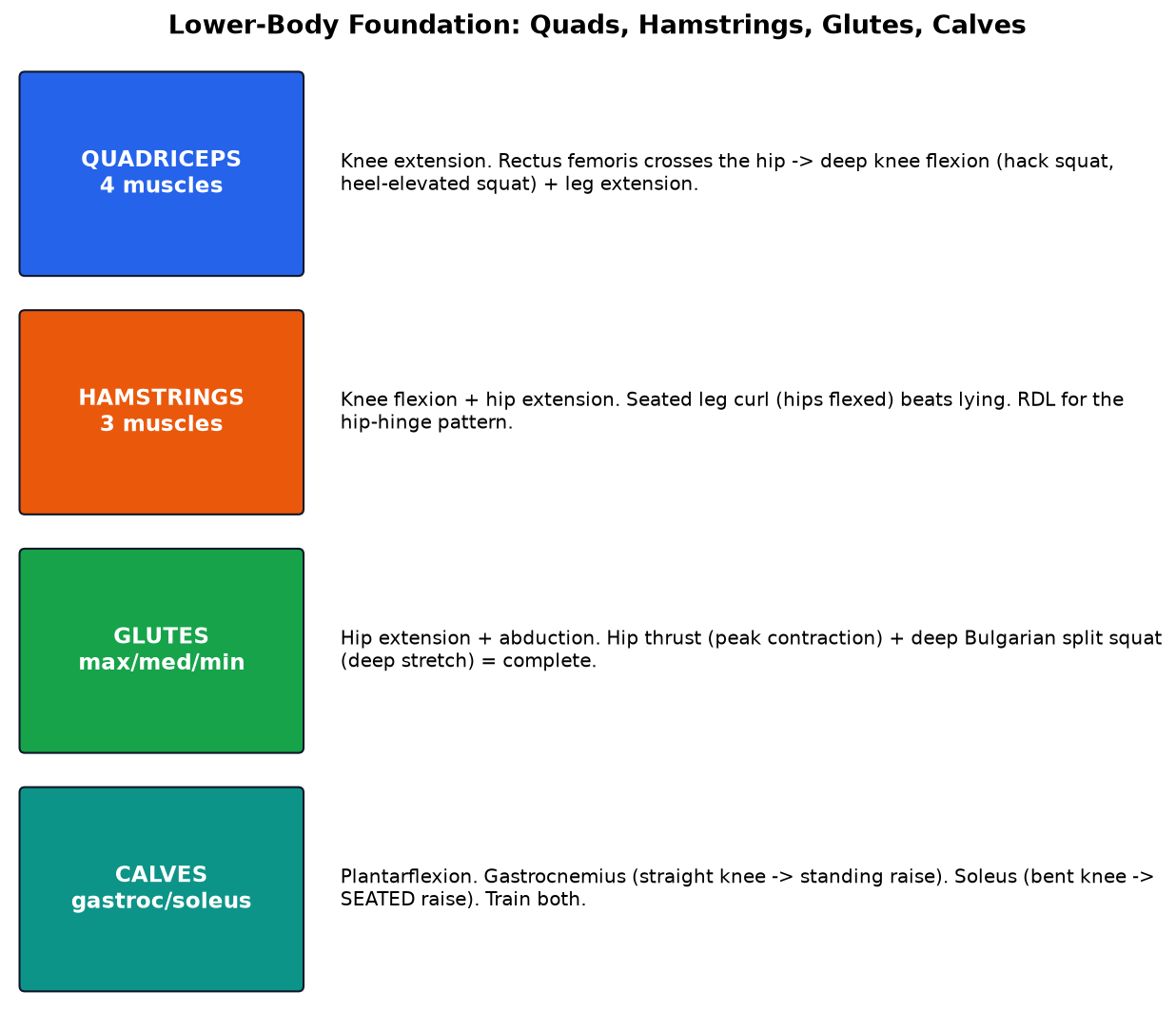
Figure 5.1 — The lower-body foundation: quad pistons, hamstring cords, the glute engine, and the two-layer calf spring.
5.1 Anatomy table
| Muscle | Heads | What it does (actions) | Picture it (ELI12) |
|---|---|---|---|
| Quadriceps Femoris | Four pistons (rectus femoris crosses the hip; vastus group does not) | Knee extension; hip-extension assist in split-squat and leg-press drive | Like engine pistons on the front of your thigh that straighten the knee, the way you would kick a ball. |
| Hamstrings | Cord group behind the thigh | Knee flexion | Like strong cords behind your thigh that bend the knee, the way a hinge folds a pocket knife shut. |
| Gluteus Maximus | Single great engine (hip origin, outer-femur insertion) | Hip extension; posterior pelvic tilt (ribs-to-pelvis at lockout) | Like the big engine in your back pocket that drives your hips forward, the way you would shove a heavy sled. |
| Gastrocnemius | Medial + lateral heads (femur origin, heel insertion via Achilles) | Ankle plantar flexion; assists knee flexion | Like a two-lobed spring behind your knee that points your toes down, the way you would stand on tiptoe to reach a shelf. |
| Soleus | Flat sheet under the gastroc (tibia / fibula origin, heel insertion via Achilles) | Ankle plantar flexion, no knee action | Like a wide flat motor under the spring that keeps pushing your heel up even with a bent knee, like a backup pump. |
Stretch tips from the transcripts. Quads: build the split-squat stance from the bottom knee-down position (~18-inch bench), drive through the front-leg midfoot straight up and down into deep knee flexion; on the leg press stop before the lower back rounds. Hamstrings: on the seated leg curl touch the pad through full end range, come all the way up to a full stretch, and control every rep both ways. Glutes: high narrow feet lengthen the glute through deep hip flexion on the press; on thrusts lower into hip flexion, then finish with full hip extension plus ribs-down posterior pelvic tilt — never spinal hyperextension. Calves: straight knees and full up-down range with a bottom pause on every rep (dissipate Achilles bounce, heels below toes); bend the knees (seated) so the gastroc goes slack via active insufficiency and the soleus takes over — lock the thigh pad tight, 3-2-1 lowering below toes, full squeeze at the top.
5.2 Masterclasses
Bulgarian split squat (Squat University) — SFR moderate, descending curve. Setup: rear foot on an ~18-inch bench (lower if short), stance built from the kneeling bottom, front foot flat driving vertically. Cues: (1) Set the stance from the bottom: kneel down first, then place the rear foot behind you. (2) Drive ~90 percent of your weight straight down through the front-leg midfoot, like an elevator. (3) Match torso lean to shin angle, small gap between the feet, never a tightrope. (4) Wiggle the back-foot toes to prove the rear leg is just a kickstand. Mistakes: too-tall bench yanking a hard stretch across the front of the rear hip; stance too short (knee shoots forward) or too long (shin goes vertical and dead); seesawing forward and back instead of riding straight up and down. Single-leg loading spares the spine versus back squats, but balance and grip demand make each set costly.
Hip thrust / glute bridge (Physique Development, Bret Contreras) — SFR moderate, flat-shortened curve. Setup: upper back on the bench under the shoulder blades, bar over hips. Bridge: short knee-over-ankle range, glutes only. Thrust: full hip extension with eyes on the wall-ceiling line. Cues: (1) Upper back parked, bar over hips. (2) Bridge variant: knees over ankles, short squeeze-only range; thrust variant: bigger range. (3) Start slightly arched, finish ribs-down with a back-pocket tuck using the glutes — never the low back. (4) Brace the belly, light ab crunch at the top, slow glute-controlled lowering. Mistakes: running a full thrust in a Smith built for bridges so the bar scoops; staring up with a high chest and hyperextending at lockout; knees wandering from the ankles or chasing a final ugly rep with lost rib control. No spinal compression with the back on a bench, but heavy setup and lockout back-ache risk keep hard sets fatiguing. Work back from light triples toward old 1RM / 3RM weights with better form.
Leg press, glute bias (Physique Development) — SFR high, descending curve, stretch-biased. Setup: high narrow feet on the plate, back and glutes pinned to the seat, full-foot contact, stopping in active range before the low back rounds. Cues: (1) Feet high and narrow to lengthen the glutes fully. (2) Pin back and butt to the seat, pull the handles like seatbelts. (3) Stop just before the butt lifts or the back rounds. (4) Push through the whole foot, hips driven down into the pad. Mistakes: chasing depth until the butt lifts and the back rounds under load; going wide (shortens range, shifts work inward); knees shooting past the ankles (turns it into a quad press). Back fully supported with no balance or spinal load — the glutes fail long before the body does. The bottom of the rep is the lengthened position where glutes are most challenged.
Seated leg curl (Renaissance Periodization) — SFR high, bell-shaped curve, stretch-biased. Setup: seated leg-curl machine, pad set for full knee bend out to a full hamstring stretch. Cues: (1) Touch the pad through full end range every rep. (2) Come all the way up until the hamstrings stretch fully. (3) Own both lifting and lowering; never kick and catch. Mistakes: shortening the top stretch for extra sloppy reps; letting the pad slam or bounce. Seated and pinned with a fixed path: hamstrings stretch under load while spine and hips do nothing.
Standing calf raise, machine / Smith / single-leg / donkey / jump (Jeff Nippard, Stephanie Braswell) — SFR moderate, ascending curve, stretch-biased. Setup: balls of feet on a platform or plate, straight knees — machine pads on shoulders, Smith bar on the fleshy upper back (never the neck), one leg at a time, hinged donkey, or slight-bend explosive jump reps. Cues: (1) Heels as low as possible every rep, pause at the bottom to kill the bounce. (2) Knees straight so the outer calf, not the deeper one, works. (3) Full up-down range, squeeze the top like reaching a high shelf. (4) Same pause-and-stretch rules for Smith, single-leg, donkey and jump variants. Mistakes: bouncing off the springy Achilles instead of lifting with muscle; pulsing with feet barely below level; uncontrollable loads. Standing under load needs balance and tempts bouncing — strict paused reps cost focus. Feel the calves working; progressive overload here works across years.
Seated calf raise (Jeff Nippard, Colossus Fitness) — SFR high, ascending curve, stretch-biased. Setup: seated, knees bent, pads locked on thighs (or dumbbells on knees), forefeet on the platform, heels below toes. Cues: (1) Bent knees slacken the outer calf so the big deeper soleus takes over. (2) Thigh pad locked tight, hold the handles, no wiggle. (3) Lower slowly (~3-2-1), heels below toes, hard top squeeze. (4) Mix heavier low-rep and lighter high-rep days. Mistakes: training only standing versions and starving the soleus; fast repping with no negative, feet stopping at level; knee-crushing loads. Seated and bolted in: full-range soleus work with no balance or spinal cost.
Chapter 5 in one sentence: split-squat deep through the front midfoot, press high-and-narrow for glutes, curl seated to a full hamstring stretch, and raise calves paused — standing straight-kneed for the outer spring, seated bent-kneed for the deep motor.
Chapter 6 — The Core and Midsection: Abs, Obliques, Spine Protection
Abs are built like any muscle — loaded stretch plus progression — and the covered videos prove most popular ab training fails that test. Dr. Milo Wolf’s science-based ranking is the backbone of this chapter: its criteria are stretch emphasis, loadability, and feel with low stabilization theft.
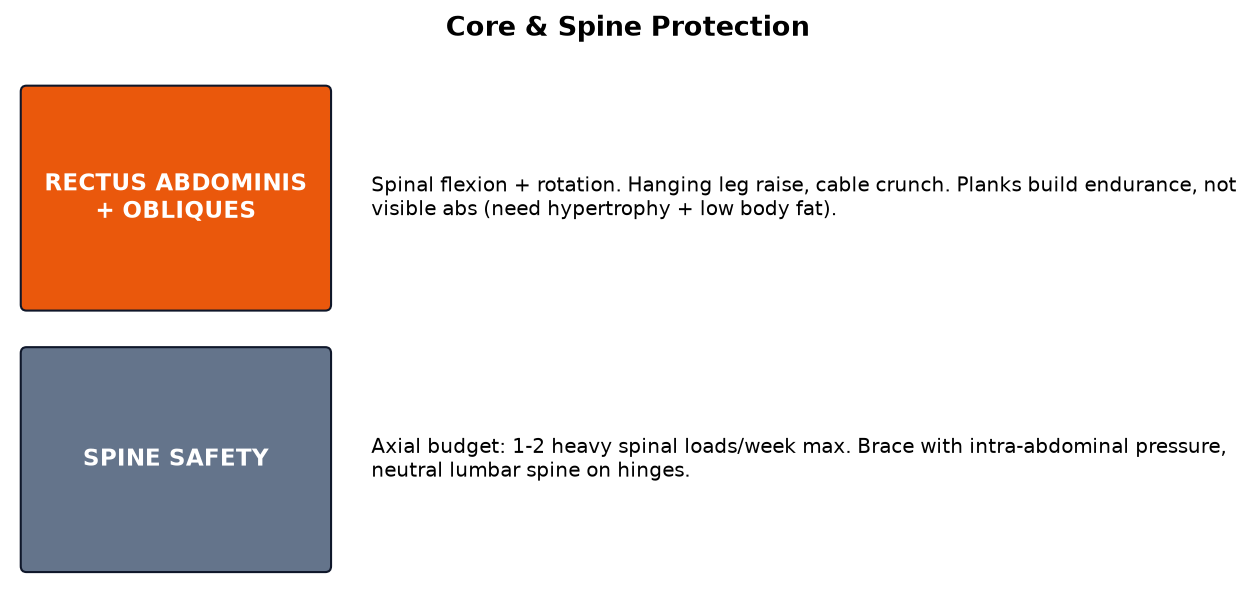
Figure 6.1 — The midsection: the segmented rectus rope, diagonal oblique straps, and the hip flexors that steal their work when form slips.
6.1 Anatomy table
| Muscle | Heads | What it does (actions) | Picture it (ELI12) |
|---|---|---|---|
| Rectus Abdominis | Segmented single rope | Spinal flexion; pelvic curl (curling the pelvis so the spine flexes) | Like a segmented rope down your belly that curls your ribs toward your hips, the way a roll-up mat folds. |
| Obliques | Diagonal side straps | Lateral flexion; spinal rotation | Like diagonal side straps that bend and twist your trunk, the way you would wring out a wet towel. |
Stretch tips from the transcripts. Rectus: lengthen under load with spinal extension, then crunch from there — cable crunch to full extension, lying raise with an extended spine on the way down, ab wheel rollout; curl the hips until knees pass the waist; strap in or use the chair when grip fails. Obliques: dumbbell side bend — bend purely sideways without shifting hips, pause deep, then come up (strap in if grip limits); twisting raises — curl from the ribcage first, then add the twist; legs are incidental.
6.2 The loaded-stretch winners (program these first)
Cable crunch (Dr. Milo Wolf) — SFR high, descending curve, stretch-biased. Setup: kneeling facing the cable, rope behind the head; full spinal extension, then crunch down under control. Cues: (1) Rope behind the head. (2) Start arched into a full stretch every rep. (3) Cable set to pull hardest in the stretch; straps on heavy sets. Mistakes: short choppy reps that never open into the stretch; yanking with the arms instead of curling the ribcage down. Kneeling and braced with stack-loaded stretch-peaking resistance — heavy ab loading with the body parked.
Lying leg raise (Dr. Milo Wolf) — SFR high, descending curve, stretch-biased. Setup: on the back, hands under glutes, legs extended; slight spinal extension on the way down for stretch. Cues: (1) Hands under glutes, arch slightly on the way down. (2) Legs up slowly — the bottom is hardest by leverage. (3) Never rush the lengthened bottom. Mistakes: rushing so momentum skips the hard stretched bottom; folding the chin or yanking the neck. Floor-supported, zero grip or hang cost — the abs own the whole rep.
Ab wheel rollout (Dr. Milo Wolf) — SFR high, descending curve, stretch-biased. Setup: ab wheel or loaded barbell; knees (feet when strong), hips tucked. Cues: (1) Roll far like a falling plank — the long bottom is where the money is. (2) Belly tight, hips tucked, low back never sagging. (3) Standing rollouts only when knee reps stay perfect. Mistakes: shortening the rollout so the bottom never loads. Brutal bodyweight leverage with no setup; the braced low back cashes the check safely.
Machine crunch (Dr. Milo Wolf) — SFR high, descending curve, stretch-biased. Setup: seated crunch machine that permits full spinal extension; select load, crunch full range. Cues: (1) Use only machines that let the spine open into a full stretch. (2) Train it like any gym lift with steady progression. (3) Crunch fully, control the return into the stretch. Mistakes: machines that block the stretch (drops this pick to C-tier); bouncing the stack. Seated, supported, stack-loaded isolation with a fixed path.
Dumbbell side bend (Dr. Milo Wolf) — SFR high, descending curve, stretch-biased. Setup: standing, dumbbell or kettlebell at one side; lateral bend to full stretch, return without shifting hips. Cues: (1) Bend straight sideways like a tipping tree. (2) No hip shifting — all motion from the waist. (3) Deep pause in the stretch; strap in when grip quits first. Mistakes: shoving the hips sideways into a hip wiggle; rushing with zero loaded pause. Dead simple one-sided oblique loading — the ranking’s oblique answer once plates are outgrown.
6.3 The honest middle (useful, not primary builders)
Hanging / captain’s chair leg raise (Dr. Milo Wolf, ATHLEAN-X, Live Lean TV) — SFR moderate, bell-shaped curve. Setup: dead hang (or forearms on chair pads, back supported); curl the pelvis to lift knees past 90 deg; twist reps for obliques; straps fix grip-limited sets. Cues: (1) Curl the pelvis so the butt swings slightly forward — that spine curl trains the abs. (2) Past 90 deg (knees above waist); stopping at 90 trains mostly hip flexors. (3) Brace like taking a punch; never swing. (4) Bend the knees as needed to earn the pelvic curl; stop short of toes-to-bar where gravity unloads the abs. (5) Chair variant: back into the pad, same curl plus side-twist versions, sparing sore shoulders. Mistakes: hip-socket bending with a straight spine (builds hip flexors, not abs); swinging while grip quits first; toes-to-bar where abs go slack. Free hanging burns grip and shoulders before the abs finish; the chair version cuts that fatigue a lot. Regression ladder: chair-supported and bent-knee options scale it to any level; the back pad limits swinging, making the chair raise easier than the free hang.
Dragon flag / candlestick (Dr. Milo Wolf) — SFR moderate, descending curve, stretch-biased. Setup: on the back holding a fixed support overhead; body raised as a lever, slow eccentric. Cues: (1) Body like a stiff seesaw. (2) Tuck the knees if the full lever is too hard. (3) Extra-slow lowering, slight arch coming down to milk the stretch. Mistakes: sloppy partials skipping the controlled lowering; bending at the hips into a leg raise instead of holding the lever. Needs full-body stiffness — most lifters leak tension elsewhere before the abs fail.
V-up (Dr. Milo Wolf) — SFR moderate, bell-shaped curve, stretch-biased. Setup: on the back; trunk crunches as legs lift together; plate-loaded when ready. Cues: (1) Fold like a closing book. (2) Hold a plate to load it — the bridge between floor raises and heavy lifts. (3) Slow lowering so the bottom never goes slack. Mistakes: jerking up and flopping down. Simple and floor-based, but bodyweight loading caps progression.
Rotary torso machine (Dr. Milo Wolf) — SFR moderate, ascending curve. Setup: seated rotation machine; controlled range, hard end squeeze. Cues: (1) Rotate slowly through the full controlled range. (2) Squeeze the turned end hard — the finish is the toughest part. Mistakes: bouncing through the start where the stretch is hardest to set. Seated support removes balance cost, but the squeeze does most of the work.
6.4 The demoted (know why they rank low)
Crunch / sit-up — SFR low, flat-shortened curve. Bodyweight floor work whose plate loading gets awkward fast. Warm-ups or finishers, never the main builder: almost no stretch, weak resistance where it matters, poor loadability.
Plank — SFR low, constant curve. A stiff-board brace-and-breathe hold. No stretch, no easy loading, long dull holds with stabilizers tiring everywhere except the abs. Move to loaded moves once a clean plank is easy; skip novelty limb waves that unload the midsection.
Russian twist — SFR low, constant curve. Seated plate rotation. A beginner stepping stone for learning trunk rotation only; graduate to side bends once the plate is outgrown instead of loading twists forever.
Cable woodchopper — SFR low, bell-shaped curve. Standing cable rotation across the torso. Light variety at best: arms and grip fail long before the obliques feel anything, and the rotation range is short.
Chapter 6 in one sentence: pick one stretch-loaded crunch (cable, machine, or wheel), one bottom-hard leg raise, and the dumbbell side bend for obliques — and stop mistaking shaky planks and fast swings for ab training.
Chapter 7 — Master Exercise Directory: All 49 Exercises at a Glance
Every blueprint from the 26 covered videos in one sortable-style table. SFR and resistance-curve ratings come straight from the analysis; Key Cue is each exercise’s most load-bearing coaching cue and Top Mistake its costliest error. Details live in Chapters 3–6.
| Exercise | Creators | Target Muscles | SFR | Resistance Curve | Key Cue | Top Mistake |
|---|---|---|---|---|---|---|
| Incline dumbbell press | Mind Pump TV, Jeremy Ethier | clavicular pec, sternal pec, front delts | moderate | descending | Pinch blades, chest up, 4-sec lower with pause | Bench too steep so shoulders take over |
| Incline bench press (15-30 deg) | John Jewett | clavicular pec, sternal pec, front delts | moderate | descending | Angle where chest squeezes before shoulders join | 45 deg or steeper becomes a delt lift |
| Flat dumbbell press | Jeremy Ethier | sternal pec, front delts, triceps | moderate | descending | Tuck 45-60 deg, press back toward shoulders | Wide flare pressing straight up |
| Flat bench press (0-15 deg) | John Jewett | sternal, clavicular, costal pec | moderate | descending | 0-15 deg trains all three fiber groups | Chasing only steep incline angles |
| Slight-decline dumbbell press | Jeremy Ethier | costal pec, sternal pec | moderate | descending | Bench foot raised slightly, same tuck | Wide flare handing work to front delts |
| Low-to-high cable fly | Jeff Nippard | clavicular pec, sternal pec | high | constant | Frozen elbow hinge, 15-20 slow stretched reps | Bending elbows turns it into a press |
| Pec fly (lengthened finisher) | John Jewett | sternal pec, clavicular pec | high | descending | Save for last, load the stretched bottom | Fly first, gassing out before presses |
| Dumbbell lateral raise (all variants) | Renaissance Periodization, Jeff Nippard | side delts, rear delts | moderate | bell-shaped | To parallel only, 3-4 sec lowering | Thumbs-down reps forced overhead |
| Behind-the-back cable lateral raise | ResilientPT | side delts, rear delts | high | constant | Lead with the elbow, stop at shoulder height | Raising past shoulders into the traps |
| Triceps pressdown (V-bar, bar, rope, reverse) | ScottHermanFitness, Jeff Nippard | triceps, lateral and medial heads | high | constant | Elbows pinned in front of hips, full lockout | Elbows drifting behind the hips |
| Overhead cable triceps extension (bar, rope, katana) | Jeff Nippard | triceps long head | high | constant | Face away, arms overhead, full extension | Skipping overhead work entirely |
| Dumbbell overhead extension (seated, one-arm) | Jeff Nippard | triceps long head | moderate | descending | Seated, deep stretch behind the head | Oversized dumbbells straining wrists |
| EZ-bar skull crusher | Jeff Nippard | triceps long head | moderate | descending | Arc behind head, elbows tipped back | Chopping straight onto the skull |
| Triceps kickback (cable, dumbbell) | Jeff Nippard | triceps lateral and medial heads | moderate | flat-shortened | Arm back behind torso, squeeze lockout | Swinging instead of squeezing |
| Close-grip bench press | Jeff Nippard | triceps lateral and medial heads | moderate | constant | Close grip, press through the triceps | Presses alone leave long head flat |
| Lat pulldown (narrow, parallel, single-arm) | Renaissance Periodization, Jordan Syatt | lats | high | constant | 2-sec top stretch, slow top-two-thirds negative | Pausing at the chest in weakest position |
| Pull-up (weighted, BW, assisted) | Renaissance Periodization | lats | moderate | constant | 5-10 weighted or 10-15 BW, chin-level finish | Kipping or half-hanging for fake reps |
| Narrow-grip assisted pull-up | ATHLEAN-X | brachialis | moderate | constant | Narrow overhand grip, 10-12 slow reps | Too heavy so biceps quit first |
| Chin-up | Jeff Nippard | biceps, lats | moderate | bell-shaped | Palms facing, chin over, slow lowering | Sole biceps work, back caps tension |
| Standing biceps curl (bar, EZ, DB, cable) | Jeff Nippard | biceps, brachialis | moderate | bell-shaped | Curl together, EZ outer grip driving pinkies | Alternating arms with long dead rests |
| Incline dumbbell curl | Jeff Nippard, ATHLEAN-X | biceps long head | high | bell-shaped | Arms behind torso, full extension every rep | Bench too flat, tendon yank |
| Preacher curl (45-deg, Scott, bench, machine) | Jeff Nippard | biceps | high | descending | 45-deg pad, full extension, locked elbows | Stopping short of straight arms |
| Lying dumbbell curl | Jeff Nippard | biceps long head | moderate | bell-shaped | Arms behind torso, controlled stretch-feel | Forcing extreme stretch on sore shoulders |
| Bayesian (face-away) cable curl | Jeff Nippard | biceps long head | high | constant | Face away, cable 90 deg to forearm at stretch | Standing too close, cable goes slack |
| Hammer curl (DB, cross-body, cable, Zottman) | Jeff Nippard, FunctionalMuscleFitness, ATHLEAN-X | brachialis, biceps | moderate | bell-shaped | Neutral grip curled across to opposite shoulder | Plain straight-ahead path only |
Spider curl | Jeff Nippard | biceps | low | ascending | Chest-down, zero shoulder movement | Arms drifting forward erasing stretch |
Drag curl | Jeff Nippard | biceps | low | bell-shaped | Bar glued close up the shirt | Believing it stretches the biceps |
Waiter curl | Jeff Nippard | biceps | low | bell-shaped | Plate like a tray, wrists stacked | Loading heavy on cranked wrists |
21s (modified short-full-long) | Jeff Nippard | biceps | moderate | bell-shaped | 7 seated plus 7 standing plus bottom-half partials | Old order gassing lengthened work first |
Bulgarian split squat | Squat University | quads, glutes | moderate | descending | Stance from kneeling bottom, elevator drive | Too-tall bench yanking the rear hip |
Hip thrust / glute bridge | Physique Development, Bret Contreras | glutes | moderate | flat-shortened | Ribs-down tuck, never low-back extension | Hyperextending the spine at lockout |
Leg press (glute bias) | Physique Development | glutes, quads, adductors | high | descending | High narrow feet, stop before back rounds | Depth-chasing until the butt lifts |
Seated leg curl | Renaissance Periodization | hamstrings | high | bell-shaped | Full end range in both directions | Shortening the top stretch |
Standing calf raise (machine, Smith, single-leg) | Jeff Nippard, Stephanie Braswell | gastrocnemius | moderate | ascending | Heels below toes, bottom pause every rep | Bouncing off the Achilles tendon |
Seated calf raise | Jeff Nippard, Colossus Fitness | soleus, calves | high | ascending | Knees bent, 3-2-1 lowering, hard squeeze | Fast reps stopping at level |
Hanging / captain’s chair leg raise | Dr. Milo Wolf, ATHLEAN-X, Live Lean TV | rectus abdominis, hip flexors, obliques | moderate | bell-shaped | Pelvic curl past 90 deg, no swing | Hip-hinge reps with a straight spine |
Lying leg raise | Dr. Milo Wolf | rectus abdominis | high | descending | Slight arch down, slow through the bottom | Rushing past the stretched bottom |
Cable crunch | Dr. Milo Wolf | rectus abdominis | high | descending | Start arched, crunch from full stretch | Short choppy reps with no stretch |
Ab wheel rollout | Dr. Milo Wolf | rectus abdominis | high | descending | Roll far, hips tucked, back never sags | Shortened rollout skipping the bottom |
Dragon flag / candlestick | Dr. Milo Wolf | rectus abdominis | moderate | descending | Stiff-seesaw lever, extra-slow lowering | Bending at hips into a leg raise |
Machine crunch | Dr. Milo Wolf | rectus abdominis | high | descending | Full-stretch machine, steady progression | Stretch-blocking machines |
V-up | Dr. Milo Wolf | rectus abdominis | moderate | bell-shaped | Fold like a book, slow lowering | Jerking up and flopping down |
Dumbbell side bend | Dr. Milo Wolf | obliques, lower back | high | descending | Pure sideways bend, deep pause | Hips shoving sideways |
Crunch / sit-up | Dr. Milo Wolf | rectus abdominis | low | flat-shortened | Slow and feeling, finisher only | Programmed as the main ab builder |
Plank | Dr. Milo Wolf | rectus abdominis | low | constant | Stiff board, breathe behind the brace | Endless minute-holds |
Russian twist | Dr. Milo Wolf | obliques | low | constant | Slow beginner rotation practice | Loading twists forever |
Cable woodchopper | Dr. Milo Wolf | obliques | low | bell-shaped | Tall, controlled rotation | Arms failing before obliques feel it |
Rotary torso machine | Dr. Milo Wolf | obliques | moderate | ascending | Slow full range, hard end squeeze | Bouncing through the start |
Reading the table like a coach. Sort mentally by SFR first: high-SFR rows are the skeleton of a program (cable flyes, pressdowns, overhead cables, pulldowns, preachers, Bayesians, leg press, seated curls, seated calf work, loaded crunches). Moderate rows earn their place as compounds and stretch specialists. Low rows are seasoning or object lessons — the spider curl teaches why stretch position matters, the waiter curl teaches why loadability matters.
7.1 Not yet covered — the 28 full-edition videos
These transcripts failed to download and are never cited above. The full edition adds them, unlocking rows, squats, hinges, overhead pressing, rear-delt isolation and chest-supported upper-back work:
- Heel Elevated Smith Machine Squat — Bilal Hussain (Quads)
- The Forgotten Pull-Up That Builds Massive Strength — FitnessFAQs (Back / Lats)
- Get Abs In 60 Days (Using Science) — Jeff Nippard (Abs)
- The Best Science-Based DUMBBELL Shoulder Exercises For Mass and Symmetry — Jeremy Ethier (Shoulders)
- How To: Overhead Press (Cybex) — ScottHermanFitness (Shoulders)
- Double Leg Foam Roller Hamstring Curl — Steady State Health (Hamstrings)
- HOW TO DO ROMANIAN DEADLIFTS (RDLs): Build Beefy Hamstrings With Perfect Technique — Jeff Nippard (Hamstrings)
- The Ultimate Push Workout For Muscle Growth [Chest, Shoulders, Triceps] (2023) — Jeff Nippard (Chest / Shoulders / Triceps)
- How to PROPERLY Reverse Pec Deck Fly (DO THIS) — Colossus Fitness (Rear Delts)
- Ultimate Preacher Curl Guide: Perfect Form for Massive Biceps Growth — Hayden Steele (Biceps)
- HOW TO: Chest Low-To-High Cable Fly (BIGGER UPPER CHEST) — ScottHermanFitness (Chest)
- GET MORE RESULTS: Dumbbell Press Master Class — Renaissance Periodization (Chest)
- Preacher Curls: How To Perform It Correctly — KAGED (Biceps)
- Stop F*cking Up Bulgarian Split Squats (PROPER FORM!) — ATHLEAN-X (Quads / Glutes)
- How To: Incline Chest Press (Hammer Strength) — ScottHermanFitness (Chest)
- The Best And Worst Back Exercises (Ranked By Science) — Jeff Nippard (Back)
- 8 One Arm Row Mistakes and How to Fix Them — Renaissance Periodization (Back)
- The Best and Worst QUAD Exercises (Ranked Using Science) — Jeff Nippard (Quads)
- STOP F*cking Up Face Pulls (PROPER FORM!) — ATHLEAN-X (Rear Delts / Rotator Cuff)
- STOP Doing Chest Flys Like This (5 Mistakes Slowing Your Chest Gains) — Jeremy Ethier (Chest)
- How To Do A SMITH MACHINE ROMANIAN DEADLIFT — Live Lean TV (Hamstrings)
- This T-Bar Row Mistake Is Wrecking Your Back Gains — Hafid James (Back)
- How to Perform the Half-Kneeling Lat Pulldown — Mike Robertson (Lats)
- How To Build Boulder Rear Delts: Optimal Training Explained — Jeff Nippard (Rear Delts)
- Bulgarian Split Squat Form Tutorial — MuscleWiki (Quads / Glutes)
- The Best Science-Based Triceps Exercises for Each Head — Jeremy Ethier (Triceps)
- The BEST Chest Supported Row Setup for Upper Back — John Jewett (Upper Back)
- We Tested 16 Chest Exercises, These Are Best For Growth — Jeremy Ethier (Chest)
Chapter 8 — Putting It All Together: Your Training Blueprint
This chapter grounds the whole book in one real lifter: Ahad Khan, 24, software engineer in Bangalore, training at Gold’s Gym Whitefield (full commercial gym) plus a basic office gym. As of September 2026 he is in a muscle-memory recomposition cut, 72 kg toward 68 kg, on ~1815 kcal (535 kcal deficit) with 165 g protein, 165 g carbs and 45 g fat, returning from a 3-month layoff through a 14-day ramp-up (week 1: 3-day full-body at 3–4 RIR; week 2: upper / lower at 2–3 RIR) into a 6-day PPL at 1–2 RIR with Dynamic Double Progression. His InBody flags legs a point below trunk — quads and glutes are the priority muscle. Nothing here replaces his live plan; what follows is the principles layer plus one compatible sample week that obeys the same cut, the same gyms, and the same ramp-up logic.
8.2 The axial budget across a week
Heavy spinal compression gets spent 1–2 times per week, never on consecutive days. His live plan already obeys this: the barbell RDL is the sole axial lift of the week. The book’s rule, visualized:
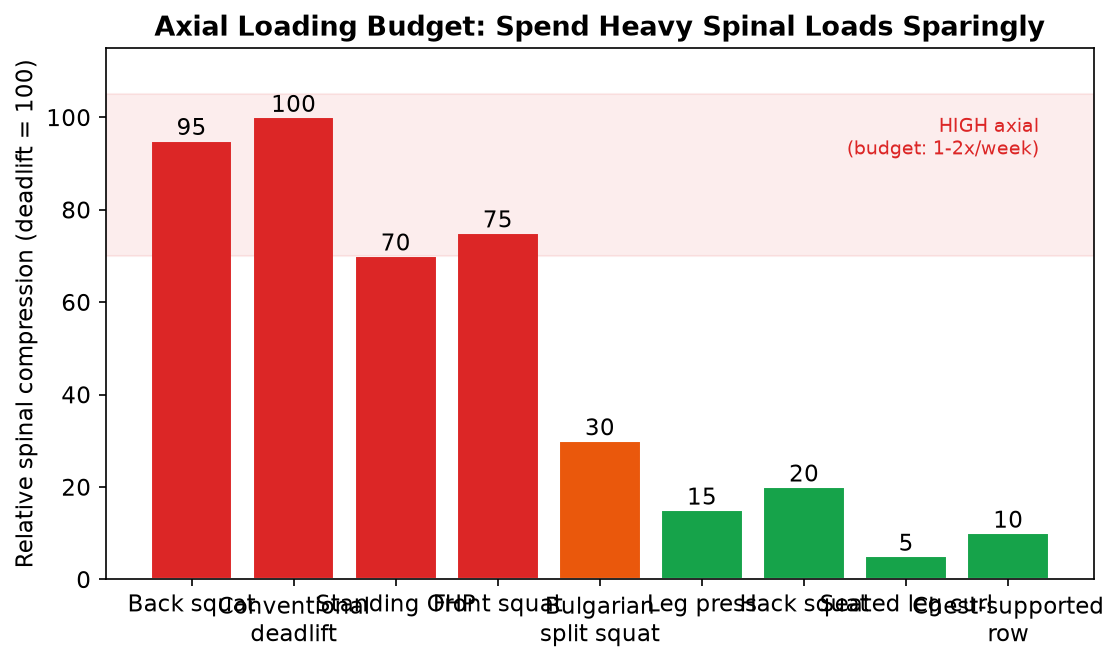
Figure 8.1 — The axial budget: one heavy spinal-loading lift per week (here the RDL), everything else seated, braced or machine-supported, and never heavy two days running.
Concretely: RDL on the posterior-chain day; hack / pendulum or Smith squat pattern, leg press, split squats, thrusts, curls and all upper-body work the other days. If the lower back still feels loaded, the first thing to cut is the second-heaviest hinge pattern, never the seated isolation work that costs the spine nothing.
8.3 DDP progression — a worked example
Take the incline DB press in an 8–12 bracket at a 1–2 RIR target. Week 1: 22.5 kg for 8, 8, 7. Week 2: 8, 8, 9. Week 3: 10, 9, 9. Week 4: 12, 11, 10 — bracket conquered, so week 5 moves to 25 kg for 8, 7, 7 and the climb restarts. Same ladder for isolation brackets (10–15 on laterals and overhead extensions, 15–20 on flyes, 6–8 on the heaviest press or RDL). During ramp-up weeks the same brackets run at 3–4 RIR (week 1) and 2–3 RIR (week 2) to reinstate the repeated-bout effect and kill DOMS before real loading starts. When the top of a bracket is hit with one rep still in reserve, add the smallest available jump — progression is a ladder, one rung at a time.
8.4 Volume landmarks on a cut
On 1815 kcal, err toward the low end: live at MEV–MAV (roughly 6–14 hard sets per muscle per week), flirt with MAV only for the priority legs, and treat MRV as a ceiling you do not touch in a deficit. Practical mapping: chest 10–12 (presses plus flyes), side delts 8–10, triceps 8–10 (pressdown plus overhead), lats 10–12, biceps 8–10 (one stretch move plus one width move), quads 10–12 across split squat / press / extension, hamstrings 6–8 seated curls plus the RDL hinge, glutes 8–10 (thrust plus glute-bias press), calves 6–8 split standing / seated, abs 6–8 (crunch plus raise plus side bend). If strength stalls two weeks running while body weight falls ~0.5 kg per week, hold volume steady and let the deficit do its job — a cut keeps muscle; it rarely builds it.
8.5 The cut-recovery stack (from his live blueprint)
Four feedings, each clearing the ~2.7–3.5 g leucine trigger for the mTORC1 foreman: breakfast power bowl with eggs (~2.8 g), chicken-rice-dahi lunch (~3.5 g), banana plus 1.5 scoops whey pre-workout (~4.1 g), chicken-rice recovery dinner (~3.3 g) — about 165 g protein inside 1815 kcal. Daily 3 g creatine monohydrate with the post-workout meal keeps the fast charger full; D3 plus K2, omega-3s, zinc and the existing sleep and step habits cover the rest. Nandini Toned Dahi (300 g daily) is the standing dairy base.
8.6 One compatible sample week (principles in action)
Same 6-day PPL rhythm as his live plan, built only from this book’s exercises, cut-calibrated. Sets × bracket at the ramped RIR.
- Push: incline DB press 3 × 8–12; flat DB press 2 × 8–12; low-to-high cable fly 2 × 15–20; behind-the-back cable lateral 3 × 10–15; pressdown 2 × 10–12; overhead cable extension 2 × 10–15.
- Pull: seated pulldown 3 × 8–12; half-kneeling single-arm pulldown 2 × 10–12; pull-up or assisted 2 × 5–10; incline DB curl 2 × 8–12; cross-body hammer cable curl 2 × 10–12.
- Legs (quad bias): Bulgarian split squat 3 × 8–10; high-narrow leg press 3 × 8–10; seated leg curl 3 × 8–12; standing calf raise 3 × 10–12; cable crunch 2 × 10–15.
- Push (second rotation): incline bench 15–30 deg 3 × 8–10; slight-decline DB press 2 × 8–12; pec-fly finisher 2 × 12–15; DB lateral raise 3 × 10–15; close-grip bench 2 × 8–10.
- Pull (second rotation): pull-up 3 × 5–10; seated pulldown 2 × 12–15; preacher curl 2 × 8–10; Bayesian cable curl 2 × 10–12; DB side bend 2 × 10–12 per side.
- Legs (posterior bias): barbell RDL 3 × 6–8 (the week’s axial spend); hip thrust 3 × 10–12; seated leg curl 2 × 8–12; seated calf raise 3 × 12–15; lying leg raise 2 × 10–15.
Deload every 4–6 weeks or whenever joints complain: halve the sets, keep the movements, let the sponge dry out.
The book in one paragraph: load muscles while they are long, pick the moves that pay the most growth per unit of fatigue, add a rep before you add weight, eat protein in leucine-cleared meals, spend your spine budget once a week — and repeat until the full edition arrives with 28 more videos.
End of the Partial Edition. Full edition adds the remaining 28 videos: rows, squats, hinges, overhead pressing, rear-delt isolation and the complete back-thickness atlas.